UK ETA for Families: Documents, Fees, and Timing

Family trips have a unique way of turning small admin tasks into big stress. When a new entry requirement like the UK ETA (Electronic Travel Authorisation) is added to the mix, parents quickly end up with the same questions: Does my child need one too? What documents do we actually need? How much will it cost for a family of four? When should we apply so we do not risk denied boarding?
This guide is built specifically for families traveling to the UK. It focuses on the practical realities of applying for multiple people, traveling with minors, budgeting for fees, and planning timing around school holidays and passport renewals.
What the UK ETA is (and why families should care)
The UK ETA is a digital pre-travel permission for travelers who do not need a visa for short stays. It is linked electronically to the traveler’s passport and is checked by airlines and carriers before departure.
Two family-specific points matter right away:
- Each traveler needs their own ETA, including children and babies.
- Your ETA is tied to the passport used in the application. If a child’s passport is renewed, the ETA does not automatically move over.
Because the UK ETA program is being rolled out in phases and eligibility depends on nationality and travel status, always confirm whether each family member needs an ETA using official guidance from the UK government.
- Official starting point: UK ETA guidance on GOV.UK
Documents you need to apply for a UK ETA as a family
The ETA application is designed to be lighter than a traditional visa, but families still need to prepare carefully, especially when applying for minors.
For each family member (adult or child)
In most cases, you should expect to provide:
- A valid passport for the traveler (the same passport they will use to enter the UK)
- A compliant digital photo of the applicant (requirements vary, so follow the instructions in the official flow)
- Basic personal details (name, date of birth, passport details, address and contact info)
- Payment method to pay the ETA fee
- Answers to eligibility and security questions (for adults, and for minors where applicable)
If you want a deeper document-focused breakdown, see: What documents do you need for a UK ETA?
Extra preparation that helps families (even if not always required)
Families commonly get slowed down by details that are easy to overlook when you are applying for multiple people in a row. Before you start, gather:
- The passports for everyone, laid out together
- A note with each traveler’s key info (full legal name exactly as in passport, passport number, issuing country, expiration date)
- Access to the email address and phone number you will use for status updates
A surprisingly common issue is a child’s name being entered differently than it appears on the passport (missing middle name, swapped surnames, extra spaces). For families, one small typo can force a reapplication and create last-minute panic.
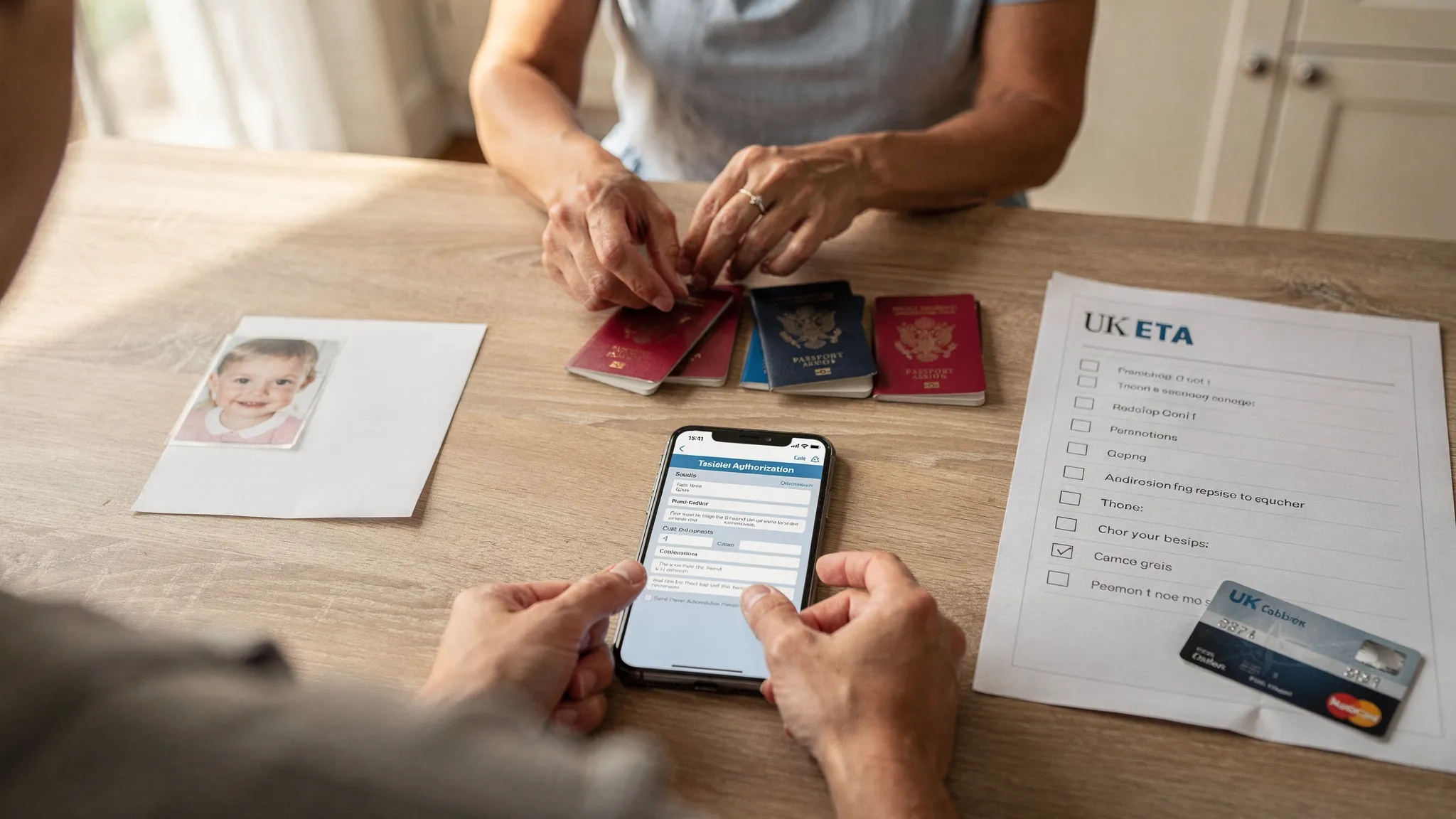
What you should carry when traveling to the UK with children (separate from the ETA)
The ETA is an electronic permission, but traveling with minors can require additional documents for airline staff or border officials, depending on your situation.
In particular, if only one parent or guardian is traveling, or if custody is shared, it is smart to carry supporting paperwork even if it is not always asked for.
Here is a practical split between ETA application inputs and travel-day documents:
| Category | Usually needed for the ETA application | Smart to carry for family travel (especially with minors) |
|---|---|---|
| Passport | Yes (for each traveler) | Yes |
| Digital photo | Yes | No |
| Proof of relationship (birth certificate) | Not typically | Sometimes helpful |
| Child travel consent letter | Not typically | Often recommended when a child travels with one parent/guardian |
| Custody/adoption/guardianship paperwork | Not typically | Recommended in complex custody situations |
| Accommodation and itinerary | Not typically | Helpful if questioned about plans |
The UK government also provides general guidance for taking a child abroad, including consent considerations: Taking a child abroad.
UK ETA fees: what families should budget for
Families mainly need to know two things about ETA costs:
- The fee is typically charged per person, not per application session.
- Fees and rules can change, so verify the latest amount before you pay.
Use the official UK ETA page for the current fee and payment rules: Apply for an ETA (official fee info).
Common fee components to understand
Even when a government fee is straightforward, the total family cost can vary depending on how you apply.
| Fee type | Who sets it | What it means for families |
|---|---|---|
| Government ETA fee | UK government | Usually paid per traveler, so multiply by the number of family members who need an ETA |
| Bank or card charges | Your bank/card issuer | Possible foreign transaction fees depending on your card |
| Optional third-party service fee | Private provider (if used) | Some families choose paid help for form guidance or error checking, which adds cost |
Budget tip: If your family has mixed nationalities, do not assume everyone needs an ETA. Check each passport, because one child may be visa-exempt while another is not, depending on citizenship.
Timing: when families should apply (and why earlier is safer)
The UK government states that an ETA decision is often quick, but it can take longer in some cases. Planning as a family is less about the best-case timeline and more about avoiding worst-case disruption.
A safe family timeline (recommended)
Here is a planning framework that works well for parents traveling during peak periods (school breaks, summer, holidays):
| When | What to do | Why it matters |
|---|---|---|
| 6 to 8 weeks before departure | Check passport expiration dates for all travelers | Passport renewal is usually the biggest schedule risk for families |
| 3 to 4 weeks before departure | Submit ETA applications for everyone who needs one | Gives time to fix errors, reapply, or adjust plans |
| 7 to 10 days before departure | Re-check approvals and passport numbers used | Helps catch the “wrong passport used” or “new passport issued” problem |
| 72 hours before departure | Confirm airline check-in details and keep digital proof accessible | If a carrier cannot verify authorization, boarding can be impacted |
How long does a UK ETA take?
Official processing guidance can vary as the program expands. Some applications are approved quickly, while others may take longer due to additional checks or data mismatches.
For the most current processing expectations, start with: UK ETA guidance on GOV.UK.
Family reality check: even if a decision is usually fast, do not wait until the night before a flight when you have multiple applications, multiple passports, and kids to manage.
Family edge cases that can change what you need
1) One parent traveling alone with a child
This is common for separated families, visiting relatives, or staggered travel dates. In addition to the child’s ETA (if required), you should consider carrying:
- A child travel consent letter from the non-traveling parent
- A copy of custody paperwork if applicable
- Contact details for the non-traveling parent
This is not just about UK border checks. Airlines may also request reassurance, because carriers are responsible for verifying that passengers meet entry requirements.
2) Blended families and name differences
If a parent and child have different last names, it is even more important to ensure the child’s ETA data exactly matches the passport.
If you want to reduce the risk of travel-day issues (beyond the ETA), carrying a birth certificate copy can help explain the relationship quickly.
3) Dual citizens in the same family
Dual citizenship can be helpful, but it can also complicate ETA needs.
- Apply using the passport your child will travel with.
- Check whether using one passport makes the child ETA-eligible while another does not.
If you are navigating dual nationality frequently, this may help: 8 tips for navigating electronic visa requirements for dual citizens.
4) A child gets a new passport after ETA approval
Because ETAs are linked to a passport, a new passport can mean the ETA is no longer valid for travel. Build this into your timing if a child’s passport is close to expiry.
If you are dealing with passport changes more broadly, see: Handling name mismatches on tickets, passports, and eVisas.
Practical tips to avoid delays when applying for multiple family members
Most ETA issues for families come down to speed and repetition. You submit one clean application, then rush the next three.
These habits reduce risk:
- Copy details directly from the passport (including middle names and spelling)
- Apply when you have time to review (not while boarding, commuting, or packing)
- Use consistent contact information so you do not miss notifications
- Keep each confirmation and reference number in one place (a shared notes app or a folder)
- Avoid last-minute passport renewals for children if possible, since a new passport can force a new ETA
For a broader, non-family-specific walkthrough of the UK ETA process, this is a useful companion read: How to apply for a UK ETA: a step-by-step guide.
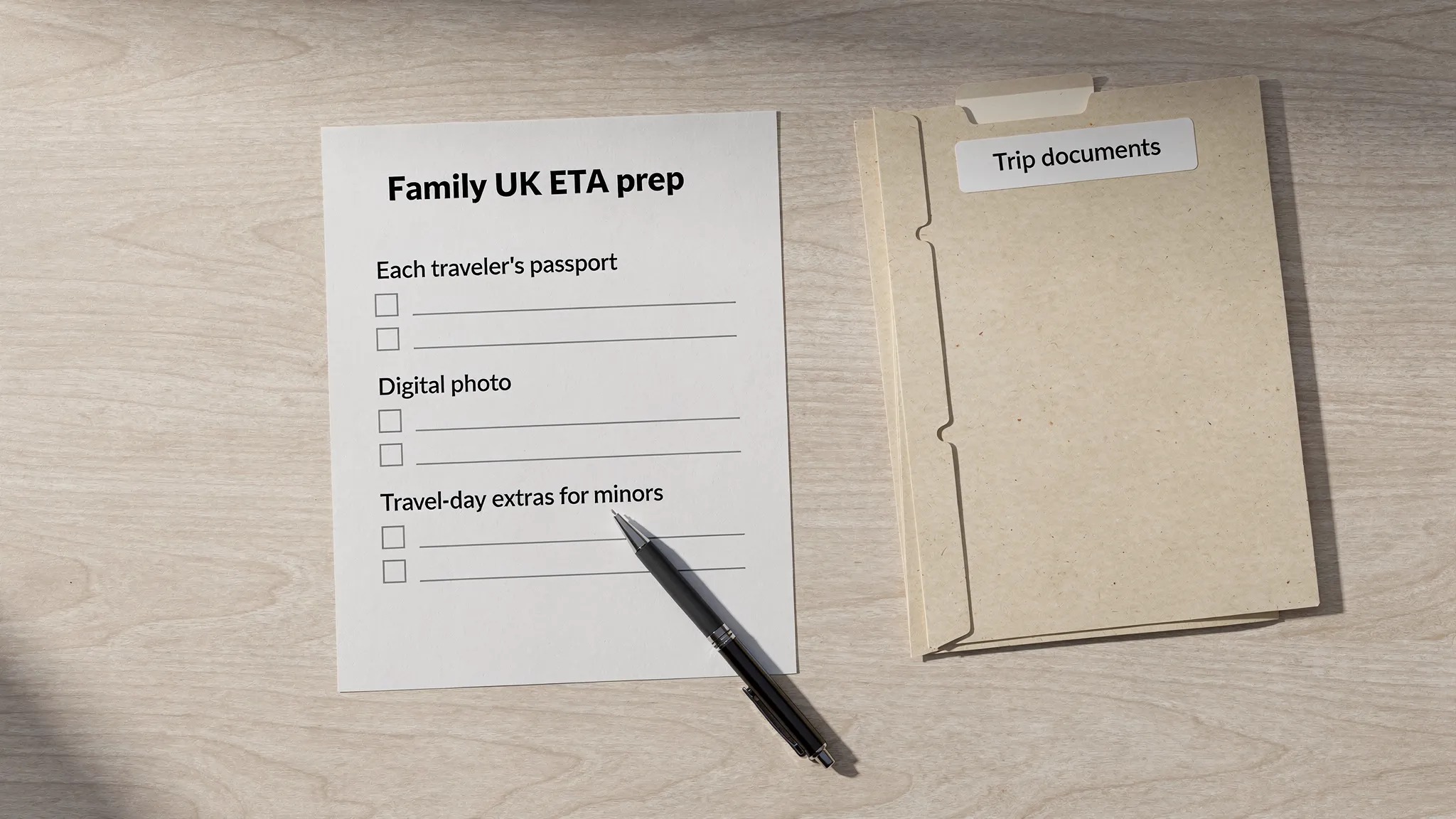
What to do if one family member’s ETA is delayed or refused
If one person in your family does not receive a decision as expected, treat it as a trip-critical issue.
Start with these steps:
- Check for status emails and spam/junk folders
- Verify the passport number and personal details you submitted
- Follow the official ETA guidance for next steps or reapplication
If an ETA is refused, the traveler may need a different permission to travel (such as a visa), depending on nationality and circumstances. In that scenario, you may need to adjust flights, split travel dates, or reroute via a different itinerary.
For travel companies booking family trips: how to reduce ETA friction
Families are among the most likely customers to abandon tasks when a requirement is unclear or appears late in the journey.
For travel brands, the most effective way to help is to surface:
- Whether the UK ETA is required based on passport nationality
- What each traveler needs to submit
- Clear timing guidance (especially around school holiday peaks)
SimpleVisa supports travel businesses with visa and travel authorization workflows that can be embedded into booking flows via API, offered through a white-label application experience, or delivered as a data service. If you are building a smoother post-booking document journey, this may help: Building a seamless post-booking visa journey: tools and templates.
Final checklist for parents
Before you hit “submit” on your family’s UK ETA applications, confirm:
- Every traveler who needs an ETA is applying (including children)
- Each application matches the passport exactly
- You are applying early enough to reapply if needed
- You have a plan for travel-day documents for minors (especially if one parent is traveling solo)
Handled early, the UK ETA can be a quick step. Handled late, it can become the one admin detail that derails an otherwise well-planned family trip.