US Travel Customer Care: Visa Playbooks That Work
Visa questions generate some of the most anxious contacts your team receives, and they are expensive to solve if you treat them case by case. The fastest‑growing US travel brands now treat visas as an operational discipline inside customer care, complete with documented playbooks, clear SLAs, and automated tools. This guide distills visa playbooks that work in US travel customer care, so you can cut avoidable contacts, prevent denied boardings, and grow ancillary revenue without hiring a small consulate.
Why visas belong in US travel customer care
- Visa, ETA and entry rules are dynamic, which makes knowledge drift a constant risk for frontline teams.
- Errors are costly, including cancellations, rebooking fees, lost loyalty, and in some regions potential carrier fines for inadmissible passengers.
- The US market uniquely blends inbound questions about ESTA and B visas with outbound questions for Americans heading to eVisa and ETA destinations.
Treating visas as a repeatable support process, not a one‑off exception, is what separates top performing care teams from the rest.
The 7 playbooks that reduce tickets and lift revenue
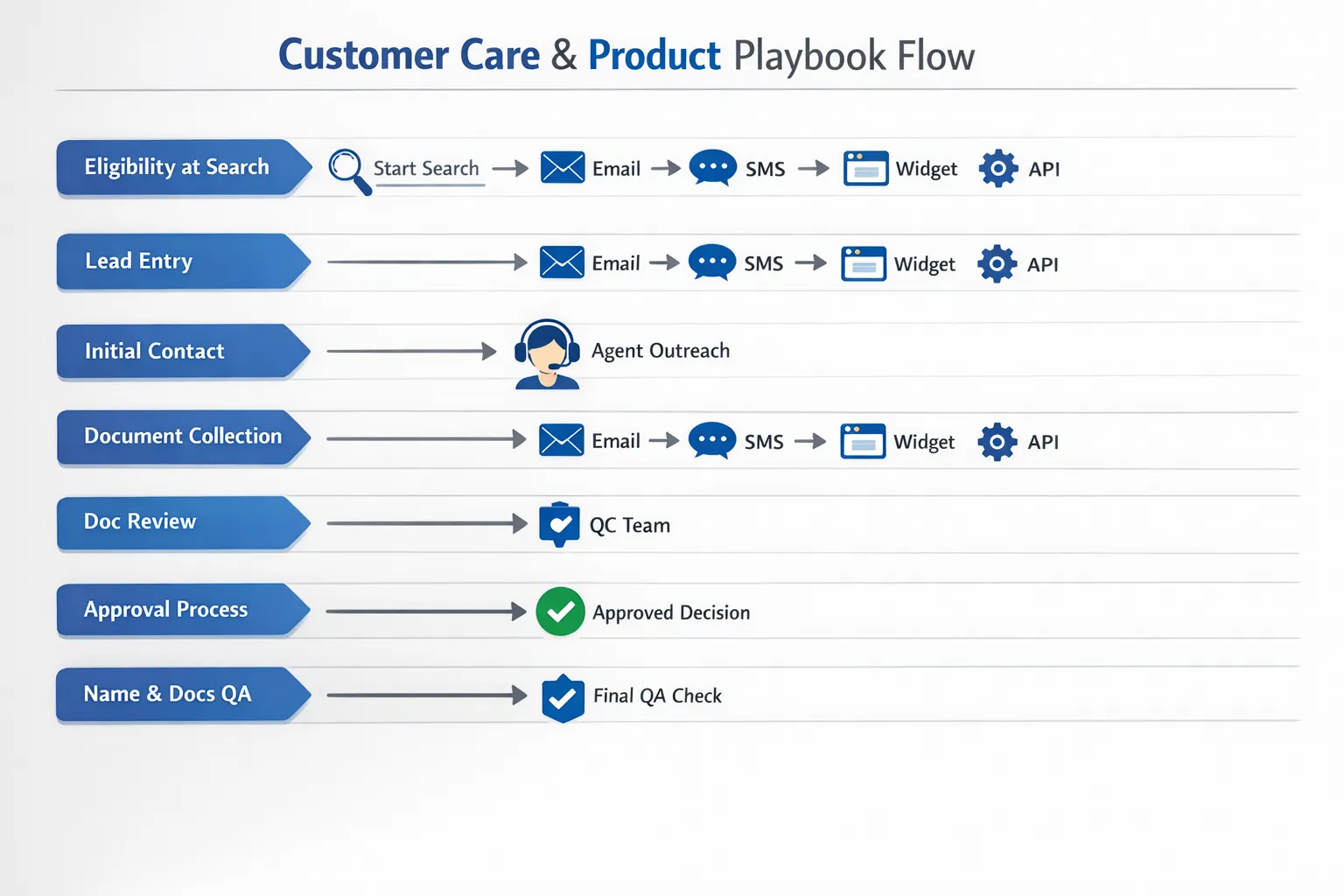
The table below summarizes the playbooks, when to deploy them, and the outcome to track.
| Playbook | Use when | Primary channel | Outcome to measure |
|---|---|---|---|
| 1. Eligibility at search | Before booking, traveler is comparing options | In‑flow banner, FAQ, chatbot | Lower pre‑sale chat volume, higher conversion |
| 2. T+0 post‑booking checklist | Immediately after purchase | Email or SMS with deep link | Faster application starts, fewer WISMO style contacts |
| 3. Guided application handoff | Traveler wants help completing forms | White‑label portal or embedded widget | Higher completion and approval rate |
| 4. 72‑hour rescue for ETAs | Departure in under 3 days, traveler lacks authorization | Priority queue, phone plus secure link | Saved trips, reduced last‑minute cancellations |
| 5. Denial recovery | Authorization refused, traveler still wants to travel | Proactive outreach, re‑application or reroute | Recovered revenue, higher NPS after issue |
| 6. Groups and events program | 10 plus passengers, time bound event travel | Project board, bulk status tracking | Fewer escalations, on‑time departure across group |
| 7. Name and docs QA | Data mismatches or missing proofs | Automated checks, macros for fixes | Lower airport escalations, fewer chargebacks |
Below, we break down each playbook with steps, sample macros, and escalation paths your team can adopt in hours, not months.
Playbook 1, Eligibility at search
Goal, set the right expectation before checkout, deflect basic queries to self‑service, and show a clear path for help.
How to run it:
- Surface a short message during search or on the trip details page, for example, “Entry documents may be required based on your passport. Check now, apply later.”
- Offer a one click eligibility check that returns the likely document and typical processing window. If you do not yet integrate, link to a lightweight checker or an FAQ.
- Add a micro‑copy note for US bound customers about ESTA timing and fee, and link to the official resource.
Helpful resources:
- U.S. ESTA overview and application are at the official site, CBP ESTA.
- For traditional US visas, refer travelers to the U.S. Department of State, US Visas.
Suggested macro for agents:
Thanks for checking. Based on your route and passport, an electronic authorization may be required. You can start now or after booking. Typical approvals are fast, but we recommend applying at least a few days before travel. I can send you a link that pre‑fills your trip details so you can complete it in minutes.
If you want a turnkey option, embed a no‑code widget or route customers to a branded portal that runs the check in context. See, API vs. White‑Label App, Which Visa Integration Model Suits You?
Playbook 2, T+0 post‑booking checklist
Goal, prevent the silent risk window after booking by nudging travelers to start early.
How to run it:
- Trigger within minutes of purchase, include, document type, earliest apply‑by date, upload tips, and a secure link to start.
- Segment by risk, fast track routes with authorization lead times or known pitfalls, for example, passport validity or transit visas.
- Add clear status states inside the order view, Not started, In progress, Submitted, Approved, with timestamps.
Copy template you can adapt:
Subject, Your trip is booked, here is your entry‑document plan
Timeline, Start today, typical approval in X to Y days. Passport must be valid for Z months after entry. Begin application, [Start now]
Tips, Have a digital passport photo, proof of stay, and your itinerary handy.
For examples and templates, see, Building a Seamless Post‑Booking Visa Journey, Tools and Templates
Playbook 3, Guided application handoff
Goal, eliminate error prone copy typing and incomplete uploads that drive refusals and repeat contacts.
How to run it:
- From the customer record, generate a secure, pre‑filled application link that includes route, dates, and traveler details already on file.
- Use an assisted flow that validates file types and photo specs as the traveler uploads.
- Show real‑time status back to your care CRM, so agents see progress without asking the traveler to re‑explain.
Result, less back and forth, higher completion and approval. SimpleVisa supports this via a white‑label app, guided applications, and an API that can be embedded in your booking or post‑booking flow.
Playbook 4, 72‑hour rescue for ETAs
Goal, salvage trips when a traveler is inside a 72‑hour window without an ETA or ESTA.
How to run it:
- Build a priority queue called “Travel in 72 hours.” Route voice and chat immediately to trained agents.
- First step is verification, confirm passport details, travel dates, and prior travel history that could affect eligibility, for example, specific sanctions or prior refusals.
- Offer an instant handoff link to a guided application that flags frequent blockers, photo quality, name order, and address formatting.
- If authorization is pending, give clear expectations, for ESTA, decisions can take up to 72 hours, see the official CBP ESTA site for timing guidance.
- If risk is high, present alternatives, move the departure by a day, offer a routing that avoids a transit visa, or propose a destination that accepts fast eVisas.
Agent macro for expectations:
I have submitted your application and you will receive a status update by email and SMS. If a decision does not arrive by [time], we will review rebooking options with you. Keep this line open and avoid duplicate submissions.
For escalation patterns and coaching, pair this with the one week curriculum in, How to Train Customer Support Teams on eVisa Rules in One Week
Playbook 5, Denial recovery
Goal, keep the booking even if the first application fails.
How to run it:
- Detect denials automatically, send a plain language explanation that maps the code to concrete next steps.
- Provide a one click re‑application wizard if the issue is fixable, for example, document clarity, data mismatch, or missing proof.
- Offer plan B options when re‑applying is not possible in time, flexible date changes, alternative routes requiring only an ETA, or curated visa friendly destinations.
This playbook is detailed in, Visa Denied? 9 Recovery Strategies Every OTA Should Offer
Playbook 6, Groups and events program
Goal, reduce chaos for groups, sports events, conferences, cruise calls, and school trips.
How to run it:
- Create a group manifest view with per traveler status and deadlines, Not started, In review, Approved, Exception.
- Assign a single owner, the group care lead, with weekly progress emails to the organizer.
- Set earlier internal deadlines, for example, start applications two weeks earlier than individual guidance.
Outcome, fewer one off calls, smoother day of travel, better organizer satisfaction.
Playbook 7, Name and documents QA
Goal, prevent last minute airport escalations and chargebacks tied to name mismatches and weak proofs.
How to run it:
- Add a pre‑departure checklist that compares ticketed name order to passport MRZ data.
- Provide macros for common fixes, airline name corrections, eVisa amendment or reissue steps, and what to carry as backup at the border.
For deeper guidance, share with agents, Handling Name Mismatches on Tickets, Passports, and eVisas, Fixes and Prevention
Scripts your agents can paste today
Short, unambiguous macros reduce average handle time and improve first contact resolution. Tailor the tone to your brand.
- Do I need a visa for this trip, and how long does it take?
I checked your route and nationality. You are likely to need an electronic authorization. Typical approvals are fast, but timing varies by country. I recommend starting today. Here is a secure link that pre‑fills your trip details, and we will notify you as status changes.
- My ESTA is pending, what should I do?
ESTA decisions can take up to 72 hours. You will receive an email from the official system when it is done. Keep an eye on your inbox and do not submit duplicates. If you do not have a decision by [time], we can review rebooking options with you.
- My name is not exactly the same on my ticket and passport.
Thanks for flagging this early. Border officers check that your ticketed name matches your passport. I can help request a name correction with the airline and verify your eVisa details so everything aligns before departure.
KPIs that matter for US travel customer care
Track these five to see the impact of your playbooks:
- Visa related contact rate per 100 bookings, trend should decline as eligibility at search and T+0 checklists go live.
- Application completion time, faster completion correlates with higher approval and fewer last minute escalations.
- Approval rate, measures quality of guidance and document checks.
- Saved trip rate, percentage of last minute rescue cases that travel as planned or within a small date shift.
- Ancillary revenue per booking, attach rate multiplied by average order value shows the business upside of getting this right.
For measurement ideas and dashboard structure, see, 5 KPIs to Track After Deploying a Visa Management Platform
Guardrails for accurate and compliant advice
- Use official sources for definitions and policy changes, CBP ESTA and the U.S. Department of State for US visas, US Visas. Share links in macros so travelers can verify.
- Avoid legal conclusions, your role is to guide through the application process and present options, not to guarantee entry.
- Collect only necessary data, store it securely, and keep an immutable audit trail for changes in case of disputes.
Tooling that makes these playbooks feasible
- No‑code, white‑label visa application app that you can link from emails, SMS, and your help center, branded to your company.
- API integration to surface eligibility, costs, and the full application inside your booking flow, customers never leave your site.
- Guided applications with validation, reduce human error on photos and document uploads.
- Status webhooks and a partner dashboard, so agents can see where every application stands without waiting on the traveler.
SimpleVisa provides all of the above, with visa processing automation, guided applications, a white‑label app, custom data services, and a no‑code implementation option used on 400 plus partner sites. For context on quality outcomes, read, Inside Look, SimpleVisa’s 99% Approval Rate Explained
Frequently Asked Questions
Does US travel customer care need to be expert in every country’s visa rules? No, but your team should know where to look and how to guide customers through a verified process. Use official links and a trusted platform for rule accuracy, and give agents concise macros and escalation paths.
What if a traveler’s ESTA is still pending on travel day? ESTA can take up to 72 hours. If no decision arrives by check in, present rebooking options and document your outreach. Do not advise duplicate submissions.
Can we complete applications on behalf of customers? Many eVisa and ETA programs allow third party assistance with traveler consent. Use a white‑label portal or API that captures consent, stores audit logs, and keeps payment transparent.
How do we handle prior refusals or complex histories? Provide a neutral explanation, link to official guidance, and outline options. If policy bars an electronic authorization, advise on consular visa routes where applicable and help with itinerary changes.
What should we say about approval guarantees? Never guarantee approval or entry. Set expectations clearly, explain typical timelines and requirements, and make sure your terms reflect that immigration authorities make final decisions.
How do we reduce name mismatch issues at the airport? Compare ticket names to passport MRZ data before departure, correct tickets through airline policies, and verify that eVisa or ETA details match exactly. Share the fix guide internally.
Turn visa friction into loyalty and revenue
If your visa questions currently mean long calls, last minute cancellations, or tense airport escalations, these playbooks will change your week one metrics. Whether you start with a no‑code white‑label app or embed eligibility and applications via API, SimpleVisa helps US travel customer care teams guide customers, increase approval rates, and create meaningful ancillary revenue.
Start a conversation with our team and see a tailored demo, SimpleVisa, Travel made simple.