US Work Visa Application: Employers, Forms, and Timelines

Navigating the U.S. work-visa labyrinth can feel daunting for both foreign talent and the HR teams that want to hire them. Deadlines are unforgiving, the paperwork is alphabet-soup, and one missed checkbox can delay a start date by months. This guide breaks down the employer responsibilities, core forms, and realistic timelines for the most common U.S. work visas so you can plan with confidence—and avoid costly surprises.
1. U.S. Work Visa Categories at a Glance
| Visa | Typical Use Case | Validity & Extensions | Primary Sponsoring Form |
|---|---|---|---|
| H-1B | Specialty occupations requiring a bachelor’s degree or higher | 3 years + 3-year extension (max 6) | Form I-129 with H Supplement |
| L-1A / L-1B | Intra-company transferees (executives/managers / specialized knowledge) | 1–3 years, extendable up to 7 (L-1A) or 5 (L-1B) | Form I-129 with L Supplement |
| O-1 | Individuals with extraordinary ability in sciences, arts, business, athletics | Up to 3 years, unlimited 1-year extensions | Form I-129 with O Supplement |
| E-2 | Treaty-investor employees & executives | 2–5 years, unlimited renewals if investment active | DS-160 + Consular Package |
| TN (USMCA) | Certain professionals from Canada & Mexico | Up to 3 years, unlimited renewals | Form I-129 (in-country) or CBP application at port of entry |
Note: Permanent, employment-based green cards (EB-1/2/3) follow a different I-140 pathway but share several preparatory steps with non-immigrant visas.
2. The Employer’s Role—More Than Just Filling Out a Form
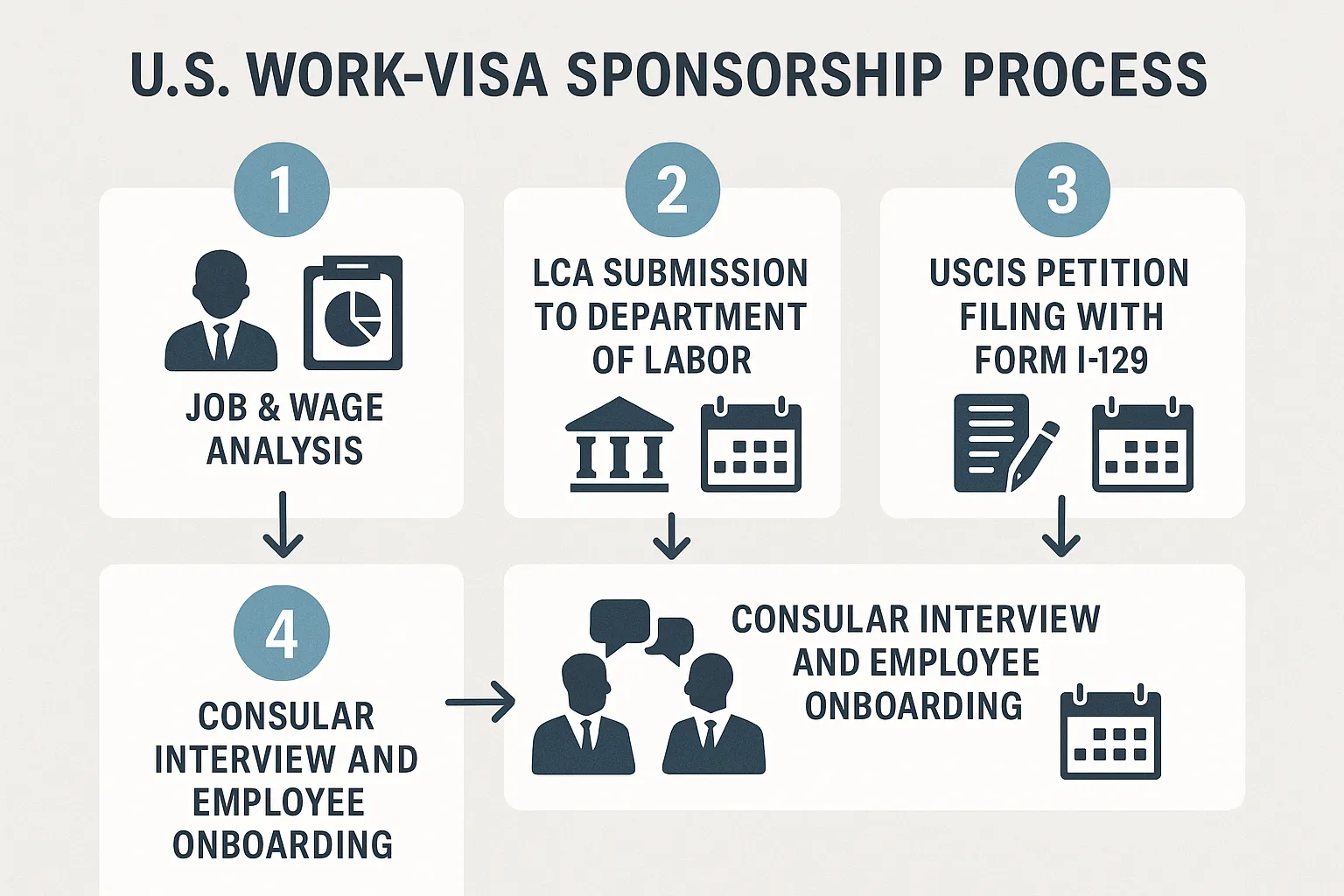
- Determine eligibility early. Job description, wage level, and candidate credentials must align with the visa’s regulatory definition (e.g., “specialty occupation” for H-1B).
- File a Labor Condition Application (LCA) or equivalent. For H-1B and E-3, Form ETA-9035 must be certified by the Department of Labor (DOL) before the USCIS petition is submitted.
- Prepare and submit the petition package. This includes Form I-129 (or DS-160 / I-140), support letters, degree evaluations, and sometimes third-party client itineraries.
- Pay the required fees. Beyond the standard $460 I-129 filing fee, H-1B employers may owe the ACWIA training fee ($750/$1,500), fraud prevention fee ($500), and optional Premium Processing ($2,805 as of Nov 2025).
- Maintain compliance after approval. Public LCA file, wage reports, I-9 re-verification, and change-of-circumstance amendments keep the company on the right side of audits.
Failing to meet any of these obligations can trigger fines or a petition denial—why many firms now rely on visa-automation platforms rather than spreadsheets and sticky notes.
3. Core Forms You’ll Meet Again and Again
| Form | Purpose | Filing Agency | When It’s Needed |
|---|---|---|---|
| ETA-9035 (LCA) | Attests to wage & working-condition compliance | U.S. Department of Labor | Before H-1B/E-3 petition |
| Form I-129 | Employer petition for non-immigrant worker | USCIS | Core petition for H-1B, L-1, O-1, TN (in-country) |
| I-129 Supplements (H, L, O, etc.) | Visa-specific evidence (e.g., itinerary, company relationship) | USCIS | Included with I-129 |
| Form G-28 | Authorizes legal representation | USCIS/Consulates | If using an attorney or accredited rep |
| DS-160 | Online non-immigrant visa application | U.S. Consulate | Visa stamping after petition approval |
| I-907 | Premium Processing request | USCIS | Optional 15-calendar-day decision |
| I-140 | Immigrant petition (green card) | USCIS | EB-1/2/3 permanent pathway |
Pro tip
Digital filing via USCIS ELIS is expanding, but many employers still submit paper petitions. An API-driven solution (like SimpleVisa’s) pulls candidate data straight from HRIS or ATS systems, reducing manual re-key errors.
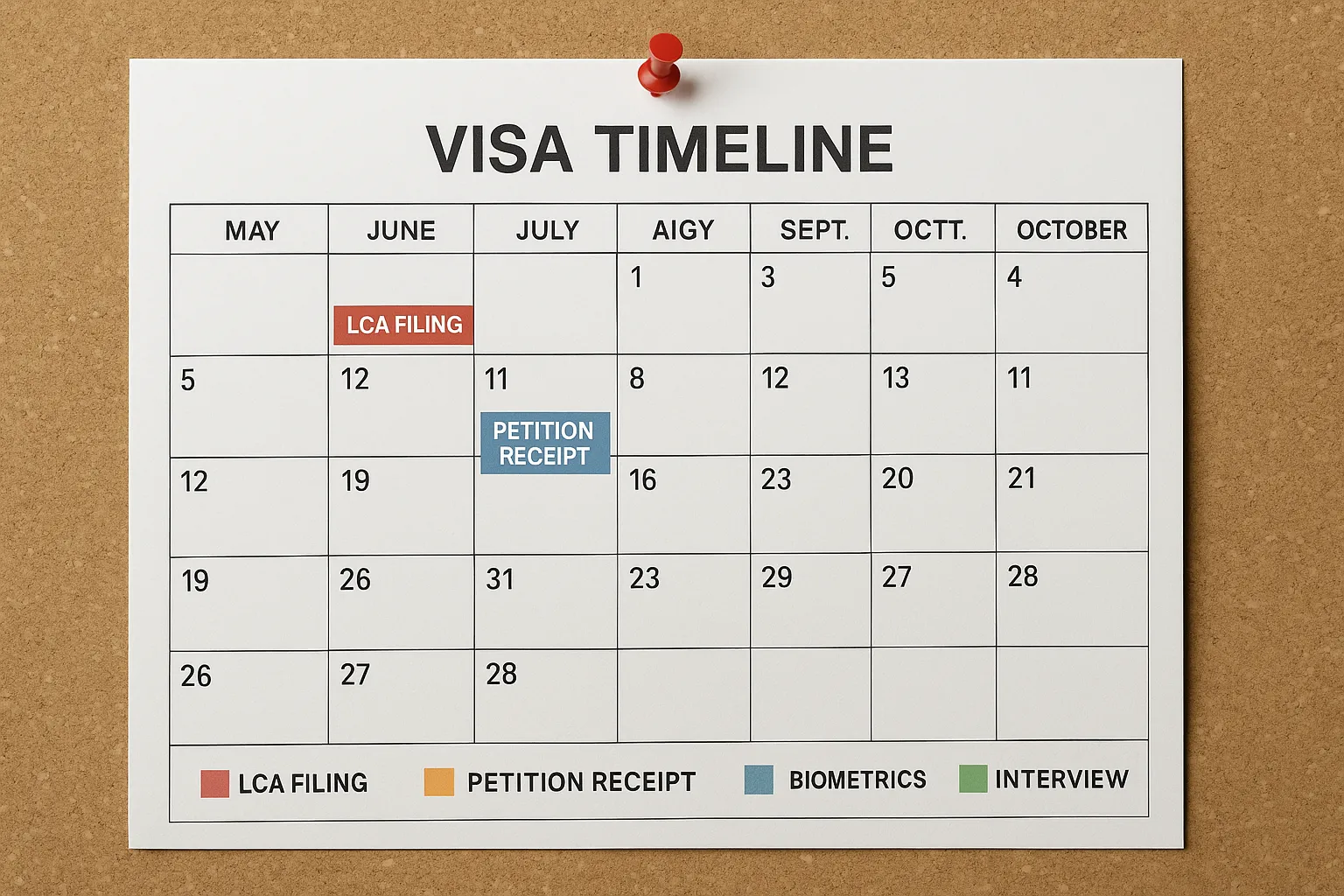
4. Realistic Timelines—from Job Offer to Arrival in the U.S.
| Stage | H-1B (FY 2026 Cap) | L-1 Blanket | O-1 (Premium) | E-2 (Consular) |
|---|---|---|---|---|
| Prevailing-wage analysis | 2–3 weeks | N/A | N/A | 2–3 weeks |
| LCA or equivalent certification | 7 days (statutory) | N/A | N/A | N/A |
| Petition prep & attorney review | 3–4 weeks | 2 weeks | 2 weeks | 3 weeks |
| USCIS adjudication | 2–9 months (regular); 15 days (premium) | 15 days (blanket) | 15 days | N/A |
| Consular scheduling & stamping | 2–8 weeks (varies by post) | 1–4 weeks | 1–4 weeks | 4–6 weeks |
| Typical total time | 6–12 months (lottery impact) | 2–3 months | 2–3 months | 3–4 months |
Remember that cap-subject H-1B filings hinge on the March electronic lottery. “Cap-exempt” employers (universities, nonprofits) can file any time.
Accelerators Employers Use in 2025
- Premium Processing (Form I-907). Guarantees a 15-calendar-day USCIS response. Now available for more categories, including EB-2 NIW.
- Blanket L-1 petitions. Large multinationals pre-qualify the corporate relationship, so individual employees apply directly at a consulate.
- Digital DS-160 autofill & kiosk fee payment. Saves applicants 45-60 minutes per submission and reduces form-field errors.
- End-to-end APIs. Travel companies and relocation firms embed SimpleVisa’s data service to fetch real-time appointment availability and auto-push reminders when a candidate’s passport or I-94 is about to expire.
5. Compliance Checkpoints After Approval
- I-9 Employment Eligibility Verification within three business days of U.S. start date.
- Reporting material changes (job site move, significant duty shift, salary cut) via an amended I-129.
- Public Access File audits. Must include the certified LCA, wage documentation, and posting evidence.
- Dependents (H-4, L-2, E-2 spouse) status tracking. Overlapping expiries are a common cause of family travel disruptions.
Failure to follow these rules can result in fines up to $35,000 per violation or debarment from future filings.
6. Common Roadblocks—and How to Avoid Them
- Quota shock: Missing the H-1B cap? Consider alternatives like L-1 (if overseas entity exists) or O-1 for high-achievers.
- Administrative Processing (221g): Provide complete client contracts, end-client letters, and itineraries up front to minimize consular hold.
- RFEs for “specialty occupation”: Attach O*NET code analysis, expert opinions, and degree-specific coursework mappings.
- Travel overlap: Coordinate visa-stamping trips after I-129 approval but before the I-94 expiry to avoid out-of-status gaps.
7. How SimpleVisa Can Help
Whether you’re an airline upselling visas or an HR team coordinating multiple hires, manual data entry is where errors blossom. SimpleVisa’s API and no-code widgets can:
- Pre-populate I-129 and DS-160 fields from your existing booking or HR platforms.
- Surface real-time fee tables and appointment slots inside your workflow.
- Send automated expiry alerts that cut last-minute panic and denied boardings.
Explore integration options in our guide on How to Offer White-Label Visa Services Without Writing Code.
Frequently Asked Questions
Do all U.S. work visas require an employer sponsor? Most do (H-1B, L-1, O-1, TN). Self-petition options exist for EB-2 NIW and some O-1-like categories but are rare.
How much does an H-1B petition cost in 2025? Government fees range from $1,710 to $6,015 depending on company size and optional Premium Processing. See our breakdown in How Much Is a US Electronic Visa?.
Can the employee start work after USCIS approval but before visa stamping? If they are already in the U.S. in valid status and the petition was filed as a change of status, yes. Otherwise, consular stamping is required before entry.
What if my H-1B employee wants a longer-term solution? Transition to an employment-based green card (I-140) well before the sixth H-1B year. Premium Processing now shortens PERM-based I-140s to 15 days.
How long can an E-2 executive stay in the U.S.? Initial validity is typically two years with unlimited two-year extensions as long as the enterprise remains viable. For details, read How Long Can I Stay in the U.S. with an E-2 Visa?.
Ready to eliminate visa guesswork and onboard talent on time? Book a 15-minute demo to see how SimpleVisa plugs into your booking or HR workflow—no code, no compliance headaches, just smoother border crossings and happier employees.