Visa Attach Rate Playbook for OTAs: From 0% to 10%

If your OTA is seeing a 0% visa attach rate, you are not alone. Most travel brands start there, even when they already have strong traffic, conversion, and post-booking comms. The reason is simple: travelers do not wake up wanting “a visa product.” They want a trip that works at the border.
This playbook is built for OTA product, growth, and ancillary teams who want to move from 0% to 10% attach rate in a structured way, without breaking the booking flow or overloading support.
What “visa attach rate” actually means (and what to measure instead)
Most teams measure attach rate as:
Visa attach rate = (number of bookings with a visa or travel authorization purchase) / (total bookings)
That’s useful for finance, but it can mislead product teams because not every booking is eligible.
A better operating metric is:
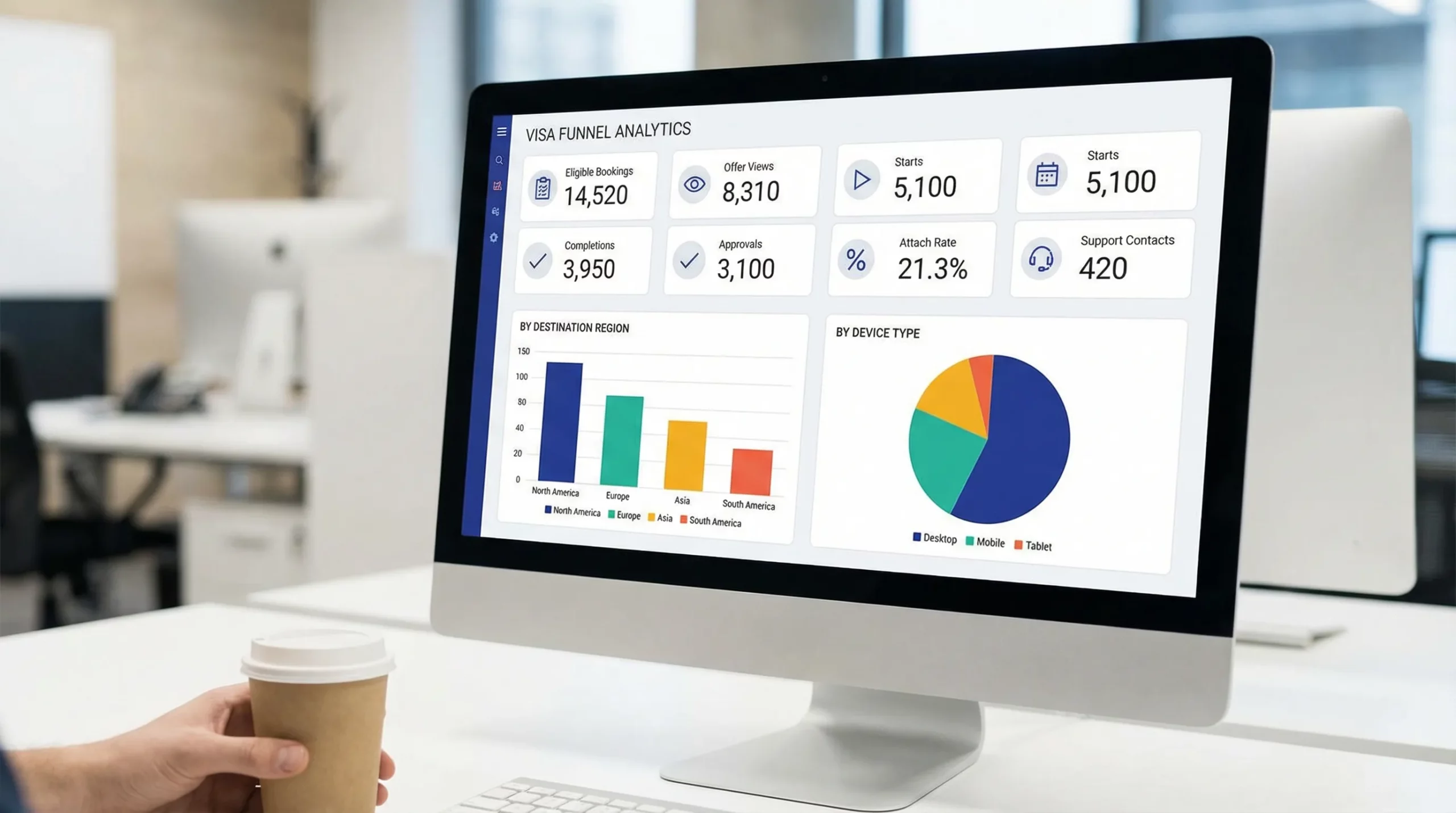
Eligible attach rate = (visa purchases) / (visa-eligible bookings)
Visa-eligible depends on nationality, destination, transit points, trip type, and sometimes timing. If you do not separate eligible from ineligible bookings, your experiments will look “flat,” even when you improved conversion meaningfully.
| Metric | Definition | Why it matters | Who owns it |
|---|---|---|---|
| Eligible attach rate | Visa purchases divided by visa-eligible bookings | True funnel conversion | Growth, Product |
| Offer view rate | Users who saw the visa offer divided by eligible bookings | Diagnoses placement | Product |
| Start rate | Users who started the visa flow divided by offer views | Diagnoses messaging | Growth |
| Completion rate | Completed applications divided by starts | Diagnoses UX friction | Product, Vendor |
| Approval rate | Approvals divided by submissions | Protects trust and re-purchase | Vendor, Compliance |
If you want a KPI framework that goes deeper (conversion, revenue per booking, completion time, approval rate, support metrics), SimpleVisa has a dedicated guide: 5 KPIs to Track After Deploying a Visa Management Platform.
Why 10% is realistic for OTAs (even if you sell mostly flights)
A 10% attach rate does not mean 10% of all bookings need visas. It means you are successfully capturing a meaningful share of the travelers who:
- Are visa-eligible
- Believe they might need a visa or eVisa
- Trust you enough to handle sensitive personal data
- Have a smooth, mobile-friendly way to apply
In SimpleVisa’s research on eVisa upsell performance across millions of bookings, the global average attach rate was reported at 7.6%, with higher-performing regions exceeding 10% in specific corridors (research summary). Your best path to 10% is to focus on high-intent segments first, then expand.
The attach rate equation: Placement + Relevance + Trust + Low friction
If you only remember one model, use this:
- Placement: did the traveler see the offer at the moment they care?
- Relevance: is it clearly tailored to their trip and passport?
- Trust: do they believe it’s legitimate, secure, and accurate?
- Low friction: can they finish on mobile with minimal re-typing?
Most OTAs that start at 0% fail on placement (offer is buried) and relevance (generic “Need a visa?” banner with no personalization). Many also underinvest in trust (no security cues) and friction (long forms, surprise document requests).
If you want a deep dive on why travelers quit mid-flow, see: Why Travelers Abandon Visa Forms and 6 UX Fixes That Convert.
Phase 1 (Weeks 1 to 3): Go from 0% to 2% with a “post-booking MVP”
Your first objective is not perfection. It is to create a measurable baseline with real traveler behavior.
What to ship first
A post-booking MVP can be:
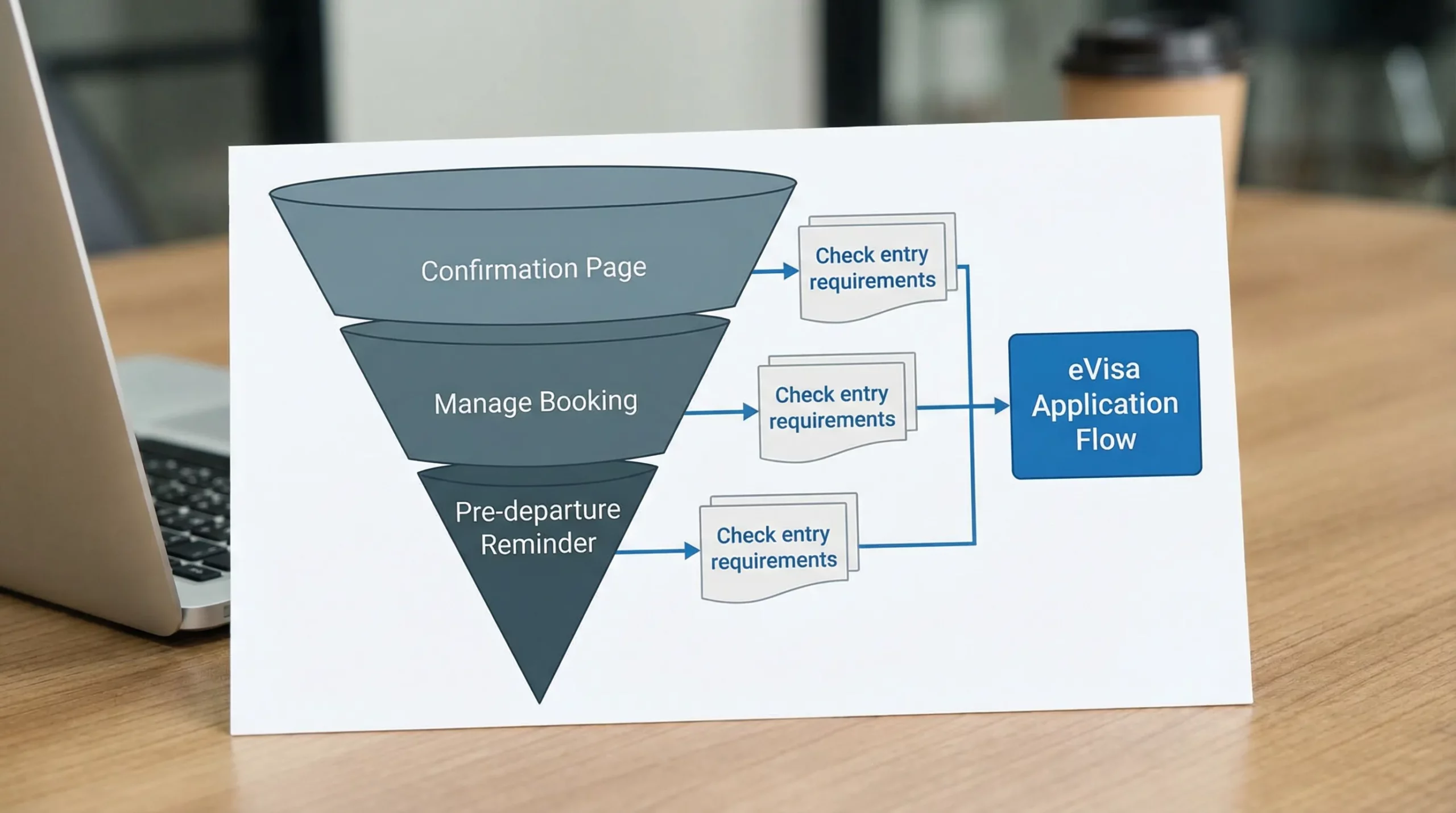
- A confirmation page module (“Check entry requirements and apply online”) targeted to likely-eligible trips
- A single follow-up email within 15 minutes of booking
- A Manage Booking module (persistent reminder)
This avoids the highest-risk stakeholder objections (“Do not touch checkout yet”) while still capturing demand.
What makes a post-booking MVP convert
- Personalized eligibility check
Do not ask the traveler to “research.” Ask them to confirm key inputs (passport nationality, destination, transit) so you can show a clear next step.
- Upfront pricing and timelines
Travelers abandon when they suspect hidden fees or unknown processing times. If you can provide transparent costs and expected timing early, your start rate jumps.
- Trust signals at the decision point
At minimum:
- Secure processing language
- “Official requirements” wording (without pretending you are a government)
- Clear explanation of what you do (guide and process the visa application)
Integration options to minimize time-to-market
SimpleVisa supports several ways to launch quickly depending on your team:
- API integration for embedding into booking flows
- A white-label visa application app
- A data service for requirements and eligibility
- A no-code implementation option
If you need an example of a quick implementation path, see: Quick Tutorial: Embedding an eVisa Widget in Under 30 Minutes.
Phase 2 (Weeks 4 to 8): Go from 2% to 5% by moving in-flow (without slowing checkout)
Once your post-booking offer works, you have evidence to justify a controlled move closer to the booking moment.
The highest-performing in-flow placements (in order)
Search and results pages (for packages or flight + hotel)
This works when you can confidently infer eligibility from the itinerary and user market.
Trip details page (pre-checkout)
This is a strong compromise: high intent, but before payment.
Checkout (only if “silent by default”)
Avoid making the visa offer a mandatory step. Use a collapsible module that can expand for relevant users.
Relevance: phrase the offer as a trip outcome, not a product
Common low-performing copy:
- “Need a visa?”
- “Apply for an eVisa here.”
Higher-performing patterns:
- “Avoid denied boarding: check entry requirements for your passport.”
- “Apply in minutes with guided steps and document checks.”
- “Get your travel authorization before departure (recommended timeline shown).”
Reduce friction with progressive disclosure
The best in-flow experiences do not dump the entire visa application in front of the traveler.
Instead:
- Step 1: Confirm passport nationality and travel dates
- Step 2: Show a decision (“You likely need an eVisa” or “No visa required”) with clear rationale
- Step 3: Start application
This structure improves conversion because you earn trust before requesting sensitive inputs.
For more booking-flow tactics, see: Ultimate Guide to Marketing eVisa Services During the Booking Flow.
Phase 3 (Weeks 9 to 16): Go from 5% to 10% using segmentation and automation
At 5%, you are no longer “testing whether visas sell.” You are optimizing a real ancillary line.
Segment where attach rate is naturally highest
Instead of trying to lift every route equally, create a “high-intent corridor” view:
- Destination regions with high eVisa usage (your own data plus market research)
- Short booking windows (last-minute travel tends to convert better)
- Mobile-heavy segments (when your flow is mobile-optimized)
SimpleVisa’s regional analysis is a useful starting point for prioritization (read the research).
Add pre-departure triggers (the attach rate multiplier)
Many travelers delay visa work. Your attach rate climbs when you add timed nudges:
- T+0: confirmation email and manage booking module
- T+3 days: reminder with “estimated processing time” (if still not started)
- T-14 days: urgency message (only if relevant)
- T-72 hours: last call plus support escalation path
If you want templates and timing ideas, see: Building a Seamless Post-Booking Visa Journey: Tools and Templates.
Make the offer feel safer than DIY
A traveler compares you with “doing it themselves” on a government portal or, worse, clicking a random search result.
Your job is to communicate:
- Accuracy (rules matched to their passport and itinerary)
- Security (data protection, safe payments)
- Clarity (no surprises on documents and fees)
- Support (what happens if they get stuck)
Experiment library: 10 high-leverage tests that typically move attach rate
Run these as controlled A/B tests where possible, and always measure the full chain: view rate, start rate, completion rate, approval rate, and support contact rate.
| Test | Hypothesis | Primary metric | Watch-outs |
|---|---|---|---|
| Add eligibility pre-check | Travelers start when they see a personalized result | Start rate | Bad data creates distrust |
| Show “time to complete” | Reduces perceived effort | Start rate | Must be realistic |
| Upfront fee disclosure | Reduces pricing anxiety | Start rate | Include what’s included |
| “Avoid denied boarding” framing | Stronger motivation than “need a visa” | Start rate | Do not overstate risk |
| Move offer earlier (trip details) | Captures intent while planning | Offer view rate, start rate | Do not disrupt checkout |
| Mobile document capture improvements | More completions on mobile | Completion rate | Needs QA across devices |
| Saved progress + reminders | Recovers abandoned applications | Completion rate | Requires identity-safe resume |
| Localized copy by origin market | Improves trust and comprehension | Start rate | Over-localization can confuse |
| Display support path | Reduces fear of getting stuck | Start and completion rate | Can increase contacts if unclear |
| Corridor-specific landing modules | Higher relevance on high-intent routes | Eligible attach rate | Avoid showing to ineligible users |
If you are earlier in the journey and still validating provider selection, this evaluation guide helps you avoid costly false starts: How to Evaluate a Visa Processing Company.
Instrumentation: the minimal event schema you need
Attach rate work fails most often because teams cannot tell whether the problem is offer visibility, traveler intent, or form friction.
Here is a minimal set of events to log (via your analytics stack, plus vendor webhooks if available):
| Event | When it fires | Required properties |
|---|---|---|
| visa_offer_viewed | Offer module rendered | itinerary_id, destination_country, channel, device |
| visa_offer_clicked | User clicks CTA | same as above |
| visa_eligibility_confirmed | Inputs confirmed | passport_nationality, destination, transit |
| visa_application_started | First application step | product_type (eVisa/eTA), price_shown |
| visa_application_submitted | Submitted to processing | submission_id, docs_count |
| visa_application_approved | Approved | approval_time, product_type |
| visa_support_contact | Traveler asks for help | reason_code, channel |
Two practical rules:
- Always log whether the booking was eligible.
- Keep a holdout group (even 5%) once you start heavy optimization, so you can measure incremental lift.
Team cadence: how to run a 90-day attach rate sprint
Visa conversion is not only a growth problem. It touches compliance, customer support, and engineering.
A simple operating model:
| Workstream | Weekly owner | Output |
|---|---|---|
| Placement and UX | Product | New modules, UI experiments |
| Messaging and CRM | Growth/Marketing | Email/SMS/push sequences |
| Data accuracy and eligibility | Ops/Compliance | Rule QA, exception handling |
| Support readiness | CX | Macros, escalation paths |
| Vendor performance | Partner Manager | SLA review, approval rate monitoring |
If you need a fast enablement plan for support teams handling eVisa questions, see: How to Train Customer Support Teams on eVisa Rules in One Week.
Common reasons OTAs get “stuck” below 5%
Showing the offer to the wrong users
Over-targeting destroys trust. If travelers repeatedly see visa offers when they do not need one, they learn to ignore it.
Treating visas as “one message” instead of a journey
Visas are inherently time-bound. A single banner rarely competes with everything else after booking. Automation and reminders matter.
Optimizing only for starts, not completions
You can double starts and still not improve attach rate if the application is too long, unclear, or mobile-hostile.
Underinvesting in trust and security cues
Visa flows collect sensitive information. If your UX looks like a generic upsell, conversion will plateau.
For security requirements you should demand from any provider, see: Top 8 Security Features to Demand in Any Electronic Visa Solution.
Where SimpleVisa fits in an OTA attach rate strategy
SimpleVisa helps travel businesses offer visa services in a way that can be embedded into booking flows or delivered via a white-label app or data service. Based on the information provided by SimpleVisa, key capabilities include:
- Visa processing automation and guided customer visa applications
- API integration for travel sites
- White-label visa application app
- Custom data services for border requirements
- Premium eVisa management
- No-code implementation option
If you are mapping where a visa layer fits into your broader platform architecture, this overview is helpful: Travel Tech Stack 2025: Where a Visa Management Platform Fits In.
Frequently Asked Questions
What is a good visa attach rate for an OTA? It depends on how many of your bookings are visa-eligible. Many OTAs aim to reach mid-single digits first, then expand toward 10% by improving targeting, placement, and completion.
Should we sell visas in checkout or post-booking? Start post-booking if you need speed and low risk, then move earlier once you have a proven baseline. Trip details pages often provide strong results without slowing checkout.
How do we avoid annoying travelers who do not need a visa? Use an eligibility-driven approach. Only show strong CTAs when a traveler is likely eligible, and default to softer “check requirements” messaging when uncertain.
What’s the biggest lever to move from 5% to 10% attach rate? Segmentation plus automation. Focus on high-intent corridors first, then add timed nudges (T+0, T+3 days, T-14 days) to recover procrastinators.
What should we track besides attach rate? At minimum: eligible attach rate, offer view rate, start rate, completion rate, approval rate, and visa-related support contacts.
Do eVisas and eTAs behave differently in conversion? Often yes. eTAs can be faster and lighter, while eVisas can require more documents. Treat them as separate products in analytics and optimization.
Next step: build your 10% roadmap
If you want to lift attach rate without guesswork, the fastest path is to run a structured 90-day plan: start with eligibility-based post-booking, move to in-flow modules, then scale with segmentation and automated reminders.
To see how SimpleVisa can be integrated via API, white-label, or no-code options, explore SimpleVisa and request a demo to map your attach-rate roadmap to your product stack.