Visa Content Cluster Strategy: Build Topical Authority Fast

Search demand around visas is huge, volatile, and fragmented. Travelers ask basic questions ("Do I need an eVisa?"), operational questions ("Can I board without ETIAS?"), and high-intent questions ("apply for UK ETA now"). Travel brands, meanwhile, search for integration, compliance, and monetization answers. A visa content cluster strategy is how you turn that chaos into predictable rankings and pipeline by organizing content the way search engines and users actually navigate the topic.
Below is a practical blueprint to build topical authority fast, without publishing hundreds of disconnected posts.
What a “visa content cluster” actually is (and why it wins)
A content cluster is a structured set of pages built around a single pillar topic, with supporting articles that cover subtopics in depth and interlink intentionally.
For visa and border requirements, clusters work especially well because:
- Search intent changes by journey stage: early research (rules), mid-funnel (how to apply, costs, timing), and late-stage (trusted channel, tracking, support).
- Policy changes create ongoing freshness needs: ETA and authorization systems roll out gradually, rules change by nationality, and travelers need clarity.
- Trust is part of the ranking equation: visa content is high stakes, so clarity, sourcing, and consistency matter.
Google’s own guidance emphasizes building a clear site structure and using internal linking to help users and crawlers understand relationships between pages. A good starting reference is Google Search Central’s site structure guidance and link best practices.
Step 1: Pick your primary audience first (not your keyword list)
Visa topics attract at least three distinct audiences. If you mix them randomly, you often get traffic that does not convert.
Audience A: Travelers (B2C intent)
They need eligibility, steps, documents, timing, and what to do when something goes wrong.
Audience B: Travel sellers (B2B intent)
Airlines, OTAs, TMCs, cruise lines, tour operators. They care about conversion, operational risk (denied boarding), support load, and ancillary revenue.
Audience C: Developers and product teams (B2B technical intent)
They care about API capabilities, authentication, implementation time, webhooks, and data accuracy.
For SimpleVisa specifically, you can support all three, but you will build authority faster if each cluster has a clear “who this is for” and a consistent conversion path (for example, traveler self-serve vs partner demo).
Step 2: Define 3 to 5 pillar pages that can “hold” the topic
Pillars should be broad enough to earn links and rank for head terms, but focused enough that your supporting pages naturally reinforce them.
A strong set of pillars for a visa-focused travel brand typically looks like this:
| Pillar theme | Best for | What it should include | Natural supporting clusters |
|---|---|---|---|
| Electronic visas and travel authorizations (eVisa, eTA, ETA) | Travelers | Definitions, differences, common requirements, how digital issuance works | Documents, timing, costs, troubleshooting, country flows |
| Travel document automation | Travel sellers | Business case, workflows, integration models, compliance impact | UX conversion, KPI tracking, ROI, post-booking journeys |
| Visa management platform (operations) | Travel sellers | How to run visas at scale, reduce support load, track status and exceptions | Support training, SLA expectations, escalation playbooks |
| Visa and travel API integration | Developers, product | Data, authentication, integration patterns, environments | Widget vs API, auth best practices, implementation tutorials |
| Border-policy changes (ETIAS, UK ETA, regional updates) | Both | What’s changing, timelines, who is impacted, how to prepare | Checklists, “common mistakes”, deadline guides |
SimpleVisa already has strong building blocks across these themes, for example:
- Traveler education: How does an electronic visa work? and Electronic Visa Processing 101
- B2B automation: What Is Travel Document Automation?
- Technical: How eVisa APIs work: Step by Step and Developer Q&A: Authenticating Against the SimpleVisa API
The fastest path to topical authority is to pick one pillar as the “center of gravity” (often Travel Document Automation for B2B), then publish a tight ring of 8 to 12 supporting pages that reinforce it.
Step 3: Build clusters around jobs to be done (not just topics)
Visa content performs best when each supporting post solves a concrete job:
- Understand (What is it?)
- Decide (Is it required for me, and is it safe?)
- Complete (How do I submit, what documents, what timing?)
- Recover (What if it’s delayed, lost, rejected, mismatched?)
- Operationalize (How do we support customers and scale it?)
Here is what that looks like for a B2B pillar (Travel Document Automation), using examples of content SimpleVisa already has so you can connect and strengthen it.
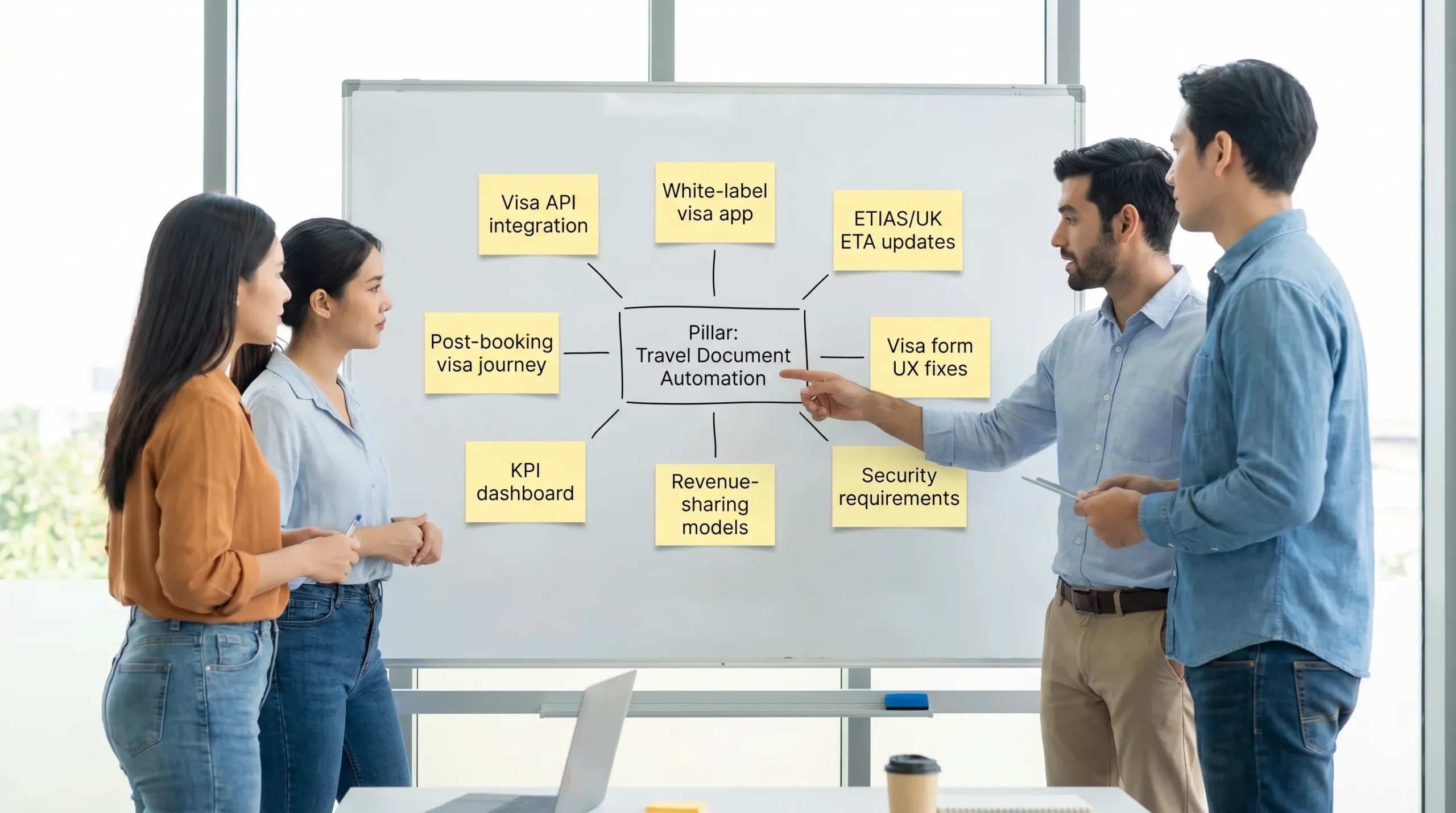
Example cluster: “Travel document automation” (B2B pillar)
Cluster pages that support the pillar and capture mid to high-intent searches:
- Conversion and UX: Why Travelers Abandon Visa Forms, and 6 UX Fixes That Convert
- Commercial strategy: 7 Revenue-Sharing Models for Online Visa Processing Partners
- Measurement: 5 KPIs to Track After Deploying a Visa Management Platform
- Journey design: Building a Seamless Post-Booking Visa Journey: Tools & Templates
- Implementation choice: API vs. White-Label App: Which Visa Integration Model Suits You?
Internal linking rule for clusters:
- Every supporting page links back to the pillar using descriptive anchors (not “click here”).
- The pillar links out to all supporting pages in a curated “Start here” section.
- Supporting pages cross-link only where it genuinely helps the reader complete the job (for example, UX fixes linking to KPIs for measurement).
This structure reduces orphan pages and increases the odds that Google understands your site as an authority on the connected concept, not just the individual keyword.
Step 4: Avoid cannibalization with “one intent per URL” mapping
Visa sites are especially prone to cannibalization because many keywords look similar:
- “How to apply for an electronic visa”
- “How do I get an electronic visa”
- “Electronic visa application step by step”
If you publish three near-identical guides, you split link equity and confuse rankings.
A cleaner cluster strategy is:
- One canonical “how to” pillar for the broad query space.
- Several supporting pages that go deep on a sub-problem (documents, timing, common mistakes, security, extensions, transfers).
SimpleVisa already leans this way, with strong sub-problem coverage like checklists and edge cases. Your cluster strategy should formalize it by assigning each URL a clear, non-overlapping role.
Step 5: Make your internal linking feel like product navigation
Clusters are not just an SEO tactic, they are user experience. Visa content that converts behaves like a guided journey.
Recommended linking modules (simple, high impact)
- “Related next steps” block at the end of each article (2 to 4 links).
- Inline links only when they remove friction (“need the document list?”).
- Breadcrumbs and consistent category paths for pillars and clusters.
Keep anchors specific. Example:
- Good: “track visa status updates”
- Weak: “learn more”
This is aligned with Google’s preference for crawlable, descriptive internal links (see the Search Central link guidance above).
Step 6: Bake EEAT into the cluster (visa content is trust content)
Topical authority in visas is not only volume. It is consistency, sourcing, and operational credibility.
Practical EEAT checklist for visa clusters
- Cite primary sources when stating rules: government immigration pages, official program sites, or government press releases.
- Separate policy facts from advice: “Requirement” vs “Recommendation.”
- Use consistent terminology across the cluster (eVisa vs ETA vs eTA), and link to a glossary when needed. (SimpleVisa has a strong foundation with The Complete Glossary of Electronic Visa Terminology.)
- Refresh policy-sensitive pages on a cadence (monthly or quarterly, and immediately after major policy updates).
For B2B buyers, EEAT also includes proving you understand operational realities: support load, edge cases, fraud risk, and compliance exposure. Content like security requirements and authentication best practices is part of your credibility, not just developer documentation.
Step 7: Ship a 30 day “authority sprint” (fast, realistic)
“Build topical authority fast” is mostly about focus and sequencing.
Weeks 1 to 2: Build the hub
- Pick the pillar that matches your revenue motion (often Travel Document Automation or Visa API integration).
- Add a curated table of contents that points to 6 to 10 supporting URLs (existing or planned).
- Update older posts to link back to the pillar.
Weeks 2 to 4: Publish the spokes that unlock rankings
Aim for supporting posts that:
- Answer one sub-intent thoroughly
- Have clear internal links to the pillar and 1 to 2 sibling pages
- Include a practical artifact (checklist, template, KPI definitions, decision framework)
SimpleVisa already has several “spokes” that tend to perform well for B2B conversion, including KPI tracking, integration model comparisons, and post-booking journey design.

Step 8: Measure cluster performance as a system (not page by page)
Clusters win when the whole topic area lifts: rankings, impressions, assisted conversions, and lower support friction.
A simple measurement model:
| What to measure | Why it matters | Where to track it |
|---|---|---|
| Non-branded impressions across the cluster | Early sign you are earning topical visibility | Google Search Console (query and page filters) |
| Share of top 10 rankings for target intents | Confirms authority is consolidating | Rank tracking tool plus GSC |
| Internal click-through from pillar to spokes | Shows whether the hub actually guides users | Analytics events, heatmaps |
| Leads or demo requests assisted by content | Connects authority building to pipeline | Analytics attribution, CRM |
| For embedded flows: attach rate and completion rate | Confirms content supports revenue and UX | Product analytics (partner side) |
If your audience includes travel sellers, tie cluster performance back to commercial outcomes you already discuss elsewhere, like ancillary revenue lift and post-deployment KPIs.
Where SimpleVisa fits (without forcing a product pitch)
A cluster strategy should naturally lead readers to the next logical step. For SimpleVisa’s audience, that step is usually one of these:
- Travel brands exploring how to add visa services into booking or post-booking flows (API, white-label, or no-code implementation).
- Product and CX teams trying to reduce visa-related abandonment and support burden.
- Developers validating integration and authentication patterns.
If you want a clean “conversion cluster” that supports those outcomes, connect your pillar and spokes to practical implementation content such as:
- How to Offer White-Label Visa Services Without Writing Code
- How eVisa APIs work: Step by Step
- Ultimate Guide to Marketing eVisa Services During the Booking Flow
And when readers are ready, direct them to the simplest next action: explore SimpleVisa’s solutions at SimpleVisa and start an integration or partnership conversation.
The takeaway: topical authority is an architecture problem
If you already publish visa content, you are probably closer than you think. The fastest wins usually come from:
- Choosing 3 to 5 pillars that match how people search and how you sell
- Tightening clusters around specific jobs to be done
- Fixing internal linking so the site behaves like a guided visa journey
- Measuring the cluster as a system, not as isolated posts
Do that well, and you will not just rank for “electronic visa” style head terms. You will earn visibility across the entire decision path, from early questions to high-intent integration searches.