Visa Help for Group Travel and Shared Applications

Coordinating visas for a group trip can feel simple at first: one destination, one itinerary, one departure date. Then the details arrive. One traveler has a passport expiring soon, another is a dual citizen, two children need guardian consent, and the business traveler in the group needs a different visa category from everyone else.
That is why visa help for group travel is different from ordinary individual support. The goal is not just to submit several forms. It is to keep every traveler aligned, reduce mistakes, protect sensitive data, and make sure one incomplete application does not disrupt the entire trip.
Whether you are organizing a family vacation, a student tour, a corporate delegation, a cruise group, or a packaged trip for customers, this guide explains how shared applications work, what to prepare, and how travel businesses can use online visa processing to make group journeys smoother.
Why group visa applications are more complex
Most visa and electronic visa systems assess travelers individually. Even when a family or group can apply through the same account, each person is usually screened based on their own passport, nationality, travel history, purpose of travel, and supporting documents.
This matters because a group itinerary can hide individual differences. A traveler with a different citizenship may need an eVisa while the rest of the group is visa-free. A child may need a separate authorization. A passenger transiting through a third country may need an additional travel document. A traveler attending meetings may need a business visa rather than a tourist visa.
Airlines and travel companies often rely on structured travel document data, such as systems like IATA Timatic, to help determine entry requirements. But for travelers, the practical challenge remains the same: requirements can change by nationality, destination, route, travel date, and purpose.
For group organizers, the risk is multiplied. If one application is delayed, rejected, or submitted under the wrong passport number, the entire group may need to adjust flights, hotels, transfers, or event schedules.
Shared applications: what “shared” actually means
A “shared visa application” rarely means one visa for everyone. In most cases, it means a shared workflow: one organizer, account, agency, or platform helps collect information and manage several individual applications together.
Some government portals allow family or group submissions, while others require each traveler to complete a separate application. Systems such as ETIAS, eTAs, and many eVisas are typically linked to the traveler’s passport, not to the booking reference or group leader. The European Union, for example, explains on its official ETIAS information page that travel authorizations are connected to the traveler’s travel document.
The exact process depends on the destination, but the operating principle is consistent: organize as a group, verify as individuals.
| Application model | Best suited for | What to watch |
|---|---|---|
| Individual self-service | Small groups where every traveler is comfortable applying online | Inconsistent answers, missed deadlines, duplicate support questions |
| Family or group portal | Families, school trips, tour groups, sports teams | Each traveler may still need a separate authorization and document set |
| Representative-assisted application | Travelers who authorize one organizer or agency to help | Consent, data privacy, and accuracy checks are essential |
| Travel business integration | OTAs, airlines, tour operators, TMCs, cruise lines | Requirements should be surfaced early in the booking or post-booking journey |
The safest approach is to assume every traveler needs an individual eligibility check until the destination’s official rules confirm otherwise.
The group visa checklist every organizer should build
Before collecting documents, create a simple traveler matrix. This is a master record that tracks who is traveling, what passport they will use, where they are going, why they are traveling, and what has been submitted.
A shared spreadsheet can work for a small family trip, but travel businesses and larger groups should use a secure system rather than email attachments or open-access documents. Passports, financial evidence, photos, and medical records are sensitive personal data.
| Item to verify | What to collect or confirm | Why it matters |
|---|---|---|
| Passport details | Full name, passport number, issuing country, expiry date, nationality | eVisas are usually tied to the passport used in the application |
| Route and itinerary | Destination, transit countries, arrival airport or port, travel dates | Transit and multi-country routes can trigger extra requirements |
| Purpose of travel | Tourism, business, study, conference, cruise, sports, medical, transit | Choosing the wrong visa category can cause refusal or entry problems |
| Traveler age | Adults, minors, infants, seniors | Children often need their own authorization and may require guardian consent |
| Supporting documents | Photos, hotel bookings, invitations, proof of funds, insurance, event letters | Requirements vary by visa type and destination |
| Contact and consent | Email, phone, representative authorization, parent or guardian approval | Needed for updates, legal consent, and application follow-up |
| Status and deadline | Not started, documents missing, submitted, approved, refused, correction needed | Helps prevent last-minute surprises for the group |
For a deeper preparation framework, SimpleVisa’s visa application checklist is a useful companion resource before submission.
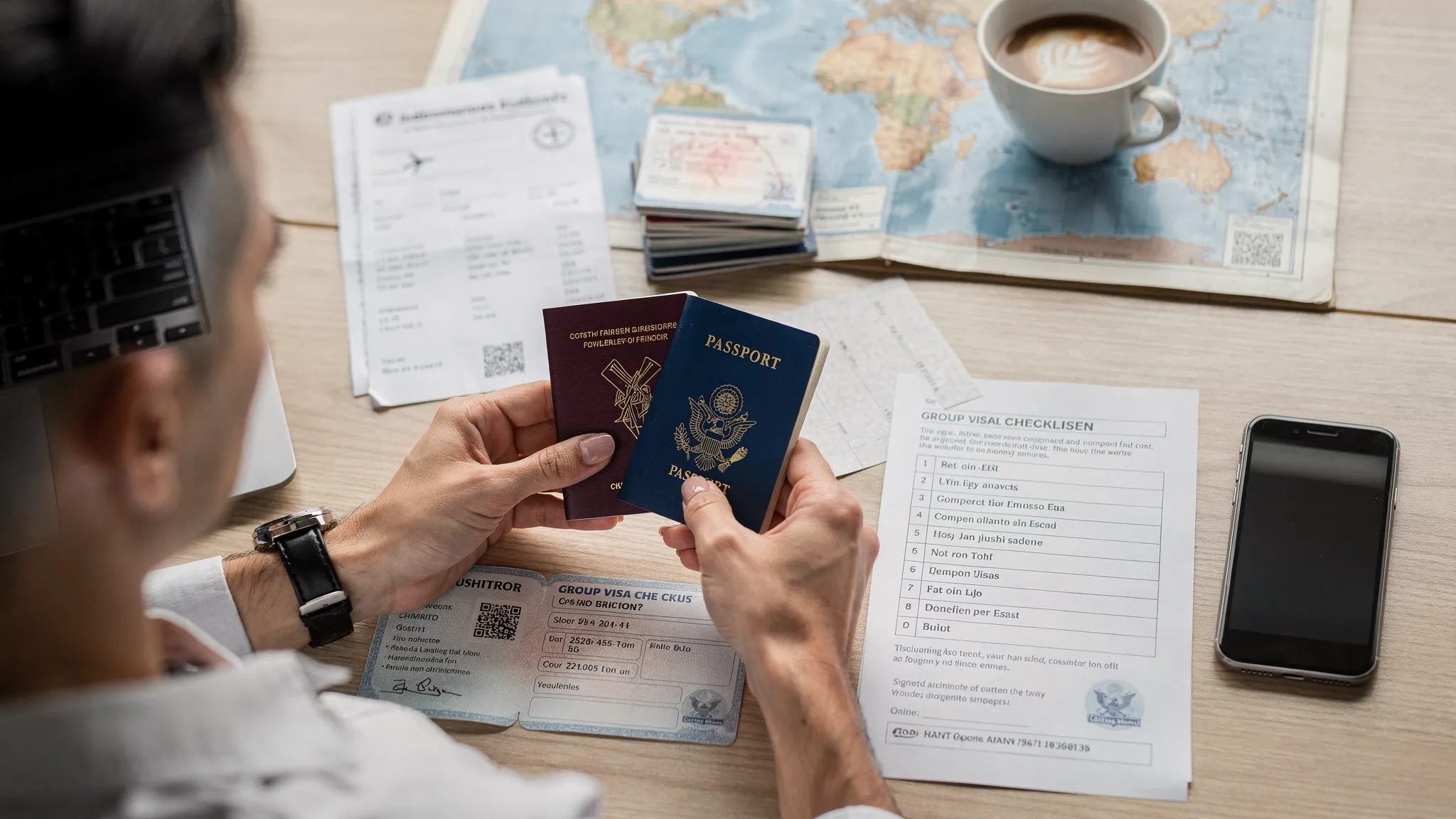
Common group travel scenarios and what to consider
Family trips with children
Families often assume that children are automatically covered by a parent’s travel authorization. In many cases, they are not. Minors may need their own eVisa, ETA, or travel authorization, even if they are listed on the same trip booking.
Parents should check whether the destination requires birth certificates, consent letters, custody documents, or notarized permission when a child travels with one parent, relatives, a school, or another adult. Name differences between parents and children can also create questions at borders, especially when surnames do not match.
Corporate delegations and incentive travel
Business groups need careful visa category checks. A short meeting, trade show, conference, sales visit, training session, or site inspection may fall under different rules depending on the destination. Some travelers may qualify for a business eVisa, while others may need a traditional visa or additional invitation documents.
For corporate travel managers, the biggest challenge is consistency. Applications should match the traveler’s actual activity, employer information, invitation letter, hotel details, and return itinerary. A mismatch between the stated purpose and supporting documents can delay approval.
Student, sports, and cultural groups
School trips, sports teams, music groups, and cultural delegations often involve minors, chaperones, and group leaders. These trips may require extra proof of supervision, institutional letters, event invitations, competition schedules, or guardian consent.
The organizer should also confirm whether every traveler is entering for the same purpose. For example, athletes, coaches, parents, and spectators may not all qualify under the same visa category.
Tours, cruises, and multi-country itineraries
Group tours and cruises can create hidden border crossing requirements. A traveler may be visa-free for the main destination but need authorization for a transit country, a shore visit, or a second leg of the itinerary.
Cruise itineraries are especially sensitive because rules can vary by port, nationality, length of stay, and whether the passenger disembarks. Multi-entry requirements also matter. If the group exits and re-enters a country, a single-entry visa may not be enough.
Mixed-nationality groups
Mixed-nationality groups are common in corporate travel, international schools, destination weddings, and tours sold through online travel agencies. They require individual checks for every traveler.
One nationality may be eligible for an electronic visa, another may need a consular visa, and another may not need a visa at all. Permanent residency can also affect requirements in some destinations, but it should never be assumed to override nationality-based rules unless the official policy says so.
A practical workflow for shared visa applications
A strong group process prevents small errors from becoming travel disruptions. Use this workflow whether you are coordinating five relatives or hundreds of customers.
- Freeze the itinerary before applying: Confirm destinations, transit points, arrival dates, departure dates, accommodation, and ports of entry before starting applications.
- Build a traveler matrix: Record each traveler’s passport country, passport expiry, age, purpose of travel, and special circumstances such as dual citizenship or prior refusals.
- Check requirements traveler by traveler: Do not rely on the group leader’s nationality or the majority of the group. Each passport can produce a different result.
- Collect documents securely: Use encrypted upload tools or a trusted visa management platform rather than unsecured email chains whenever possible.
- Review names against passports: Copy names exactly as they appear in the passport, including middle names, order of names, hyphens, and special characters where required.
- Submit in batches with tracking: For large groups, submit complete applications in controlled batches so missing documents do not hold everyone back.
- Create approval backups: Save approved eVisas or authorizations in a secure shared system, and make sure each traveler can access their own copy before departure.
This workflow is especially valuable when applications are time-sensitive. Even fast electronic visa systems can slow down if a traveler is sent for manual review, uploads an unreadable passport scan, or uses a passport that differs from the ticket.
Data privacy is not optional
Group visa coordination involves sensitive information: passport scans, dates of birth, home addresses, employment details, financial documents, family relationships, travel history, and sometimes health information.
Organizers should collect only what is needed, restrict access to authorized people, and avoid forwarding personal documents through long email threads. For businesses, privacy laws such as GDPR or other national data protection rules may apply depending on where travelers are located and how data is processed.
Travel companies should also define retention rules. Once a visa application is complete, decide how long documents need to be stored, who can access them, and when they should be deleted. This is where structured travel document automation is safer than ad-hoc manual handling.
How travel businesses can simplify group visa support
For airlines, OTAs, tour operators, cruise lines, TMCs, and travel agencies, group visa support is both a customer experience challenge and an ancillary revenue opportunity.
If visa requirements are only mentioned after booking, customers may feel surprised or unsupported. If agents handle every question manually, support costs rise quickly. If no one checks requirements at all, travelers may face denied boarding, missed departures, or last-minute cancellations.
A visa management platform can help by bringing eligibility checks, online visa processing, and guided applications into the customer journey. SimpleVisa supports travel businesses with visa processing automation, API integration for travel sites, white-label visa application apps, custom data services, guided customer applications, premium eVisa management, ancillary revenue opportunities, and no-code implementation options.
For group travel, the value is strongest when visa help appears at the right moment.
| Travel journey stage | Useful visa support | Business benefit |
|---|---|---|
| Search or booking | Show visa or eVisa requirements based on route and passport | Reduces uncertainty before purchase |
| Checkout | Offer guided visa application as an add-on | Creates ancillary revenue while solving a real customer problem |
| Post-booking | Send reminders, document checklists, and application links | Lowers support tickets and missed deadlines |
| Pre-departure | Confirm approval status and highlight missing applications | Reduces operational disruption and denied boarding risk |
| Group management | Track multiple traveler statuses in one workflow | Gives organizers visibility across the entire party |
Travel brands can choose different implementation models depending on their technical resources. A no-code or white-label option may be best for fast launch, while an API integration can provide deeper control inside a booking flow. SimpleVisa’s guide to API vs. white-label visa services explains how to compare those options.
If your team is still defining the broader operating model, the guide to travel document automation is a good starting point.
Mistakes that commonly delay group applications
The most common group visa mistakes are rarely dramatic. They are usually small inconsistencies repeated across many travelers.
A group leader may enter their own email for everyone, then miss an action request for one passenger. A traveler may upload a passport scan with glare or cropped machine-readable lines. Someone may renew their passport after submitting an eVisa application, forgetting that the approval is linked to the old passport. A business traveler may choose “tourism” because it seems faster, even though their invitation letter clearly states a conference or meeting purpose.
Another frequent mistake is waiting until every traveler has every document ready before beginning the process. For large groups, this can create avoidable delays. It is often better to identify complete applications early, submit them in organized batches, and escalate missing items separately.
Finally, group organizers should avoid assuming that approval for one traveler predicts approval for everyone else. Visa decisions depend on individual facts, and an eVisa approval does not guarantee entry. Border officers may still ask questions on arrival, so travelers should carry supporting documents that match the application.
Frequently Asked Questions
Can one person apply for visas for an entire group? Sometimes one person can help manage applications as a representative, parent, guardian, agency, or organizer, but each traveler usually still needs an individual visa, eVisa, or travel authorization. Always check the destination’s official rules.
Do children need their own electronic visa? In many destinations, yes. Children and infants often need their own authorization if the entry requirement applies to them. Additional consent or custody documents may also be required when minors travel without both parents.
What if everyone in the group has a different nationality? Each traveler should be checked separately. Visa-free access, eVisa eligibility, consular visa requirements, fees, and processing times can vary significantly by passport country.
Can a travel agency manage shared visa applications for customers? Yes, if the agency has the traveler’s consent and uses a secure, compliant process. A structured visa management platform is generally safer and more scalable than collecting documents through email.
How early should a group start the visa process? Start as soon as the itinerary is stable and passport details are available. Even if a destination offers fast eVisa processing, groups need extra time for missing documents, corrections, manual reviews, and travelers with special cases.
Does an approved eVisa guarantee entry for the group? No. An approved visa or eVisa allows the traveler to seek entry, but border authorities can still ask questions and make final admissibility decisions. Travelers should carry matching documents and follow the conditions of stay.
Make group visa applications easier with SimpleVisa
Group travel should not be slowed down by fragmented forms, scattered passport scans, and last-minute requirement checks. SimpleVisa helps travel businesses simplify border crossing administration through automation, guided customer visa applications, API integrations, white-label options, and no-code implementation paths.
If your customers book family trips, tours, cruises, corporate travel, student travel, or multi-country itineraries, adding visa help directly into the journey can improve confidence, reduce support workload, and create a valuable ancillary revenue stream.
Learn how SimpleVisa can support your group travel workflows at SimpleVisa.com.