Visa Requirements API: 9 Questions to Ask Vendors

For airlines, OTAs, TMCs, cruise lines, and tour operators, visa uncertainty appears at the exact moment a customer is trying to buy. If your booking flow cannot answer “Do I need a visa?” quickly and accurately, the traveler may abandon the trip, contact support, or arrive at the airport without the right document.
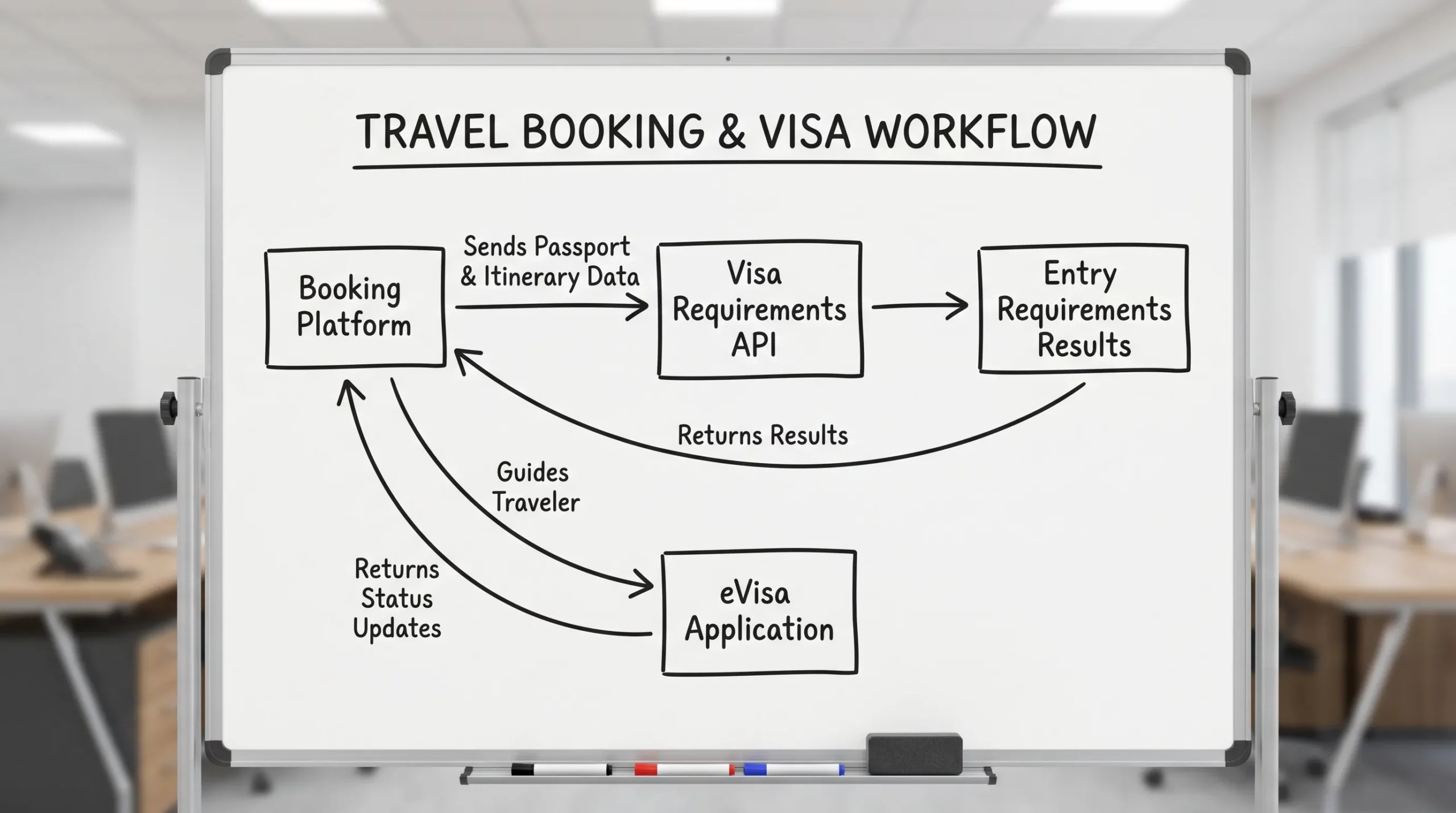
A Visa Requirements API can solve that problem by turning passport, itinerary, and travel-purpose data into clear entry guidance. The challenge is that vendors vary widely. Some provide only static requirement data. Others support guided applications, eVisa processing, white-label flows, status tracking, and revenue-sharing models.
Use the questions below to evaluate vendors before you commit engineering resources, compliance reviews, or commercial forecasts.
What a Visa Requirements API should actually do
At minimum, a Visa Requirements API should determine whether a traveler needs a visa, eVisa, ETA, transit authorization, or no pre-travel document for a specific trip. A stronger solution also explains what to do next, what documents are required, how long processing may take, and whether the traveler can complete the application inside your booking or post-booking experience.
The best APIs do not treat visa rules as a simple country-to-country lookup. Requirements can change based on passport nationality, residence, destination, transit points, purpose of travel, duration of stay, travel dates, port of entry, age, and sometimes previously issued visas or permits.
If you want a deeper technical overview, SimpleVisa’s guide on how eVisa APIs work explains the typical data flow from requirement check to application submission and confirmation.
| Capability | Basic requirement lookup | Mature Visa Requirements API |
|---|---|---|
| Rule logic | Passport and destination only | Passport, residence, dates, transit, trip purpose, stay length, and edge cases |
| Output | “Visa required” or “not required” | Requirement type, eligibility, documents, timing, fees, and next steps |
| Application support | External redirect or none | Embedded application, white-label flow, or API-powered submission |
| Updates | Periodic manual refresh | Versioned updates, change logs, and time-stamped rules |
| Business value | Compliance support | Compliance, conversion, ancillary revenue, and reduced support load |
1. What coverage do you actually provide?
Coverage is the first question, but it should not stop at “How many countries do you cover?” A vendor may claim broad global coverage while missing high-friction use cases such as transit visas, cruise shore requirements, dual citizenship, minors, business travel, or country-specific eVisa categories.
Ask vendors to define coverage across three layers: destinations, traveler profiles, and document types. A useful API should account for visas, electronic visas, electronic travel authorizations, passport validity rules, and supporting document requirements when relevant.
A strong vendor should be able to provide a coverage matrix showing which countries, travel purposes, and route types are fully supported, partially supported, or excluded. If your business specializes in complex itineraries, such as multi-country tours or cruise journeys, ask for examples that match your actual booking patterns.
2. How current is the data, and how do you prove it?
Visa rules change constantly. Governments introduce new eVisa systems, expand ETA requirements, adjust fees, alter validity periods, or temporarily suspend certain travel categories. A Visa Requirements API is only useful if its data is updated quickly and transparently.
Do not settle for a vague answer like “we update regularly.” Ask how updates are sourced, validated, versioned, and distributed to partners. You should also ask whether the API response includes a timestamp, source note, rule version, or confidence indicator.
For higher-risk routes, request proof of the vendor’s change-management process. For example, what happens if a destination changes its ETA requirement on short notice? How quickly is the rule updated? Who is notified? Is there a webhook, email alert, dashboard notice, or release log?
3. What traveler and itinerary inputs does the API evaluate?
A weak API asks for nationality and destination. A stronger API evaluates the real conditions that determine border requirements.
At a minimum, ask whether the API can process:
- Passport nationality and issuing country
- Country of residence when relevant
- Destination, transit, and return locations
- Arrival and departure dates
- Purpose of travel, such as tourism, business, study, or transit
- Length of stay and number of entries
- Mode of entry, such as air, land, sea, or cruise
- Age or minor status when rules differ
This matters because two travelers on the same flight may have different requirements. A U.S. passport holder, a permanent resident of another country, and a dual citizen can face different outcomes on the same itinerary. Your vendor should be able to explain how its rules engine handles these variations without forcing your support team to interpret them manually.
4. How clear and actionable are the API responses?
A response that simply says “visa required” is not enough for a modern travel business. Travelers need to know what type of authorization is required, whether they are eligible, how to apply, what documents to prepare, and when to start.
Ask vendors to show real sample responses, not just a sales deck. Look for fields that make the answer usable inside your product experience, such as requirement status, document category, application route, estimated processing time, validity information, stay limits, required documents, fee components, and recommended next action.
Also ask how the vendor handles uncertainty. Some immigration rules include exceptions or discretionary review. A trustworthy API should avoid false certainty and provide escalation paths where rules are conditional or traveler-specific.
5. Can the vendor support the full application journey?
Some vendors stop at requirements. Others connect the requirement check to online visa processing, eVisa submission, payment, document upload, status tracking, and approval delivery.
The right model depends on your commercial strategy. If you only need to inform customers before checkout, a data-only API may be enough. If you want to reduce friction, generate ancillary revenue, and keep travelers inside your brand experience, you may need a guided application flow or white-label visa application app.
Ask whether the vendor supports application initiation, prefilled forms, document validation, payment handling, customer notifications, status webhooks, and post-approval delivery. If you are comparing embedded API and hosted options, this guide to API vs. white-label visa integration models can help frame the trade-offs.
6. What will implementation require from your team?
A Visa Requirements API should not create more operational complexity than it removes. Before signing, ask vendors to walk your product and engineering teams through the implementation path.
Key technical questions include whether the vendor provides a sandbox, sample payloads, OpenAPI documentation, clear authentication patterns, predictable error codes, rate-limit policies, and test cases for common routes. You should also ask about localization, currency display, mobile rendering, and whether a no-code option exists for faster deployment.
Integration is not just a developer concern. Product teams need to know where requirement checks appear in the journey. Compliance teams need to understand what data is collected. Commercial teams need to know where offers and service fees appear. Support teams need access to traveler status and escalation context.
A good vendor should help you map all of those touchpoints before implementation begins.
7. What security and compliance controls are in place?
Visa and travel document workflows involve sensitive personal data. Depending on the product, that may include passport details, identity documents, travel history, payment information, and documents for minors. Security cannot be a late-stage procurement checkbox.
Ask vendors how they secure data in transit and at rest, how API credentials are managed, how access is controlled internally, and how audit logs are maintained. You should also ask about data minimization, retention periods, deletion workflows, sub-processors, regional data hosting, breach notification procedures, and penetration testing.
For technical due diligence, the OWASP API Security Top 10 is a useful reference for common API risks such as broken authorization, excessive data exposure, and insecure authentication. Vendors should be able to explain how their architecture addresses these risks in practical terms.
For a deeper procurement checklist, see SimpleVisa’s guide to the security features to demand in an electronic visa solution.
8. How will the API improve traveler experience and ancillary revenue?
A Visa Requirements API is not only a compliance tool. Used well, it can reduce uncertainty, increase trust, and create a natural ancillary revenue opportunity. The key is timing and clarity.
Visa guidance usually performs best when it appears where the traveler already has intent: search results, checkout, confirmation pages, trip management, and pre-departure reminders. The offer should be specific to the traveler’s route and passport, not a generic “check your visa” banner.
This principle applies across digital commerce. Even outside travel, brands such as Air Tea Company make a new product category easier to understand by explaining the experience clearly at the point of consideration. Visa services need the same level of contextual clarity: what is required, why it matters, how long it takes, and what the traveler should do now.
Ask vendors whether they support localized copy, dynamic messaging, transparent fee display, branded flows, abandoned-application reminders, and revenue reporting. If ancillary growth is part of your business case, request examples of how the vendor helps optimize attach rate without adding pressure or confusion to the traveler journey.
9. What pricing, SLAs, and reporting will govern the partnership?
Commercial terms can make two similar vendors very different in practice. A low per-lookup price may look attractive until you discover minimum commitments, overage fees, limited support, expensive implementation work, or separate charges for application status updates.
Ask how pricing works across requirement lookups, completed applications, white-label access, premium eVisa management, custom data services, support, and reporting. Clarify whether revenue share is available, whether you can apply your own service fee, and how refunds or rejected applications are handled.
You should also ask for measurable service levels. Important SLA topics include uptime, API latency, support response times, incident notification, data-update timelines, and escalation procedures during urgent policy changes.
Finally, confirm what reporting is included. At minimum, travel businesses should be able to track lookup volume, eligible travelers, application starts, completion rate, approval outcomes, revenue, support cases, and conversion by route or destination. For measurement ideas after launch, see SimpleVisa’s guide to KPIs for a visa management platform.
A practical vendor scorecard
Use this table during RFPs, demos, and procurement reviews. It keeps the conversation focused on evidence rather than broad claims.
| Vendor question | Why it matters | Proof to request |
|---|---|---|
| What coverage do you provide? | Prevents gaps on key routes and traveler types | Coverage matrix and excluded scenarios |
| How current is the data? | Reduces outdated guidance and support risk | Rule timestamps, update logs, and alert process |
| What inputs do you evaluate? | Handles real itinerary complexity | Sample payloads for edge cases |
| How actionable are responses? | Improves UX and reduces confusion | Sample JSON responses and user-facing copy |
| Do you support applications? | Connects compliance to revenue | Demo of application, payment, and status flow |
| What does integration require? | Controls time-to-market and engineering effort | Sandbox, documentation, and test credentials |
| How is data protected? | Reduces privacy, fraud, and compliance risk | Security architecture, policies, and audit evidence |
| How do you support conversion? | Turns visa guidance into a helpful ancillary | Funnel examples and reporting dashboard |
| What are the commercial terms? | Avoids hidden costs and unclear ROI | Pricing sheet, SLA, and sample invoice |
Red flags to watch for
A vendor does not need to be perfect, but some signals should slow down your decision. Be cautious if a provider cannot show rule timestamps, cannot explain edge cases, has no sandbox, offers only generic redirects, lacks documented security controls, or avoids questions about data retention.
Also watch for vendors that position approval as guaranteed. No legitimate provider can guarantee that a government will approve every visa application. A strong platform can improve application quality, reduce mistakes, and guide travelers through the correct process, but the final decision remains with the relevant authority.
How to run a better vendor demo
Do not let the demo stay at the happy-path level. Prepare five to ten real routes from your business, including at least one transit itinerary, one last-minute trip, one business traveler, one family or minor scenario, and one route where requirements recently changed.
Ask the vendor to process each scenario live. Then ask where the rule came from, when it was last updated, what the traveler would see, what your support team would see, and what happens if the application is abandoned or refused.
This approach quickly reveals whether you are evaluating a simple database, a true travel document automation platform, or a full visa management partner.
Frequently Asked Questions
Is a Visa Requirements API the same as an eVisa API? Not always. A Visa Requirements API determines what a traveler needs for a specific trip. An eVisa API may also support application submission, document upload, payment, status tracking, and delivery of the approved electronic visa. Some vendors combine both capabilities.
Who should use a Visa Requirements API? Airlines, OTAs, TMCs, cruise lines, tour operators, booking platforms, and travel marketplaces can use a Visa Requirements API to guide travelers, reduce support questions, and add visa-related ancillary revenue.
What data should we send to a visa API? Send the minimum data required to determine the rule accurately, typically passport nationality, destination, transit points, travel dates, purpose of travel, and stay length. More complex cases may require residence, age, document type, or mode of entry.
Can a Visa Requirements API prevent denied boarding? It can reduce the risk by surfacing requirements earlier and guiding travelers toward the right authorization. It cannot eliminate all risk because travelers must still provide accurate information and border authorities make final entry decisions.
How should we measure success after launch? Track requirement-check volume, application starts, completion rate, approval rate, ancillary revenue per booking, support tickets, abandoned forms, and traveler satisfaction. These metrics show whether the API is improving both compliance and commercial performance.
Choose a vendor that fits your travel business, not just your tech stack
The right Visa Requirements API should do more than return a rule. It should help your travelers understand what they need, complete the right application, and move through the journey with confidence.
SimpleVisa helps travel businesses streamline border crossing administration with visa processing automation, API integrations, white-label visa application options, custom data services, guided customer applications, and premium eVisa management. If you are evaluating vendors or planning a new visa integration, explore SimpleVisa to see how border requirements can become a smoother customer experience and a stronger ancillary revenue channel.