Visa Travel Booking: API or White Label?

Travel sellers are under pressure to make border compliance feel as easy as selecting a seat or adding a bag. In 2026, that is no longer “nice to have”. New digital authorizations (like the EU’s upcoming ETIAS and expanding ETA programs) mean more travelers will hit visa or entry-permit friction after they book, or worse, at check-in.
If you want to sell and manage visas inside your travel journey, you generally have two implementation routes:
- Visa API embedded into your booking flow
- White-label visa experience (hosted portal or branded app)
Both work. The better choice depends on your product maturity, engineering capacity, and how tightly you want visas connected to your booking funnel.
The real goal: reduce friction without breaking the booking flow
“Visa travel booking” is not just about offering a visa service. It is about placing the right compliance step at the right moment so customers do not abandon, and your support team does not drown in “Do I need a visa?” tickets.
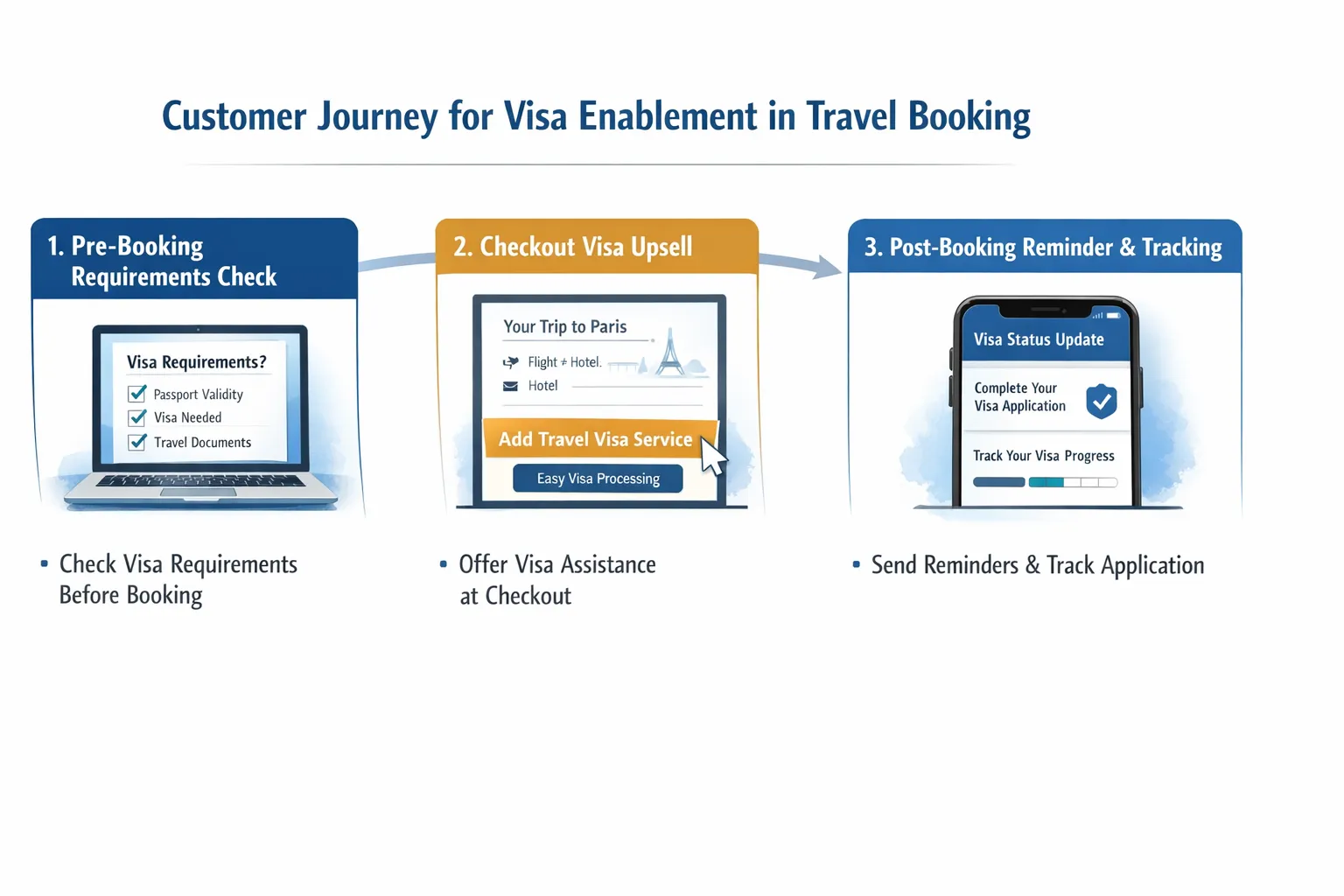
Most travel brands end up designing for three moments:
- Pre-booking reassurance: show entry requirements early (especially for international one-ways and complex itineraries).
- Checkout conversion: monetize with a visa add-on when the intent to travel is highest.
- Post-booking rescue: catch travelers who skipped or were unsure, and guide them before departure.
An API and a white-label experience can support all three, but they do it differently.
What “API” vs “white label” actually means in visa travel booking
Visa API (embedded)
A visa API approach means your site or app calls a provider programmatically to:
- Determine entry requirements based on itinerary and traveler nationality
- Initiate a guided application flow
- Track status updates and outcomes
The visa experience is typically embedded inside your product, so the traveler stays in your UI and account context.
White-label visa experience
A white-label approach means you launch a branded, hosted visa application experience that looks like your brand (logo, colors, tone), but is maintained by the provider.
Travelers are routed to the hosted flow from your booking confirmation page, email, or “Manage my trip” area.
SimpleVisa supports both approaches (API integration and a white-label visa application app), plus no-code implementation options depending on the partner setup.
API vs white label: the trade-offs that matter most
At a high level, your decision comes down to two forces:
- Speed to market and operational simplicity (white-label wins)
- Deep funnel integration and product control (API wins)
Here is a practical comparison focused on travel booking realities.
| Decision factor | Visa API (embedded) | White-label visa experience |
|---|---|---|
| Time to launch | Longer (engineering + QA + rollout) | Faster (mainly branding + routing + content) |
| UX control | Highest (you own the full journey) | Moderate (you control entry points and branding, less UI logic) |
| Checkout integration | Strongest (best for attach rate optimization) | Good, but typically routed out of the booking UI |
| Support load reduction | Strong if you surface eligibility early and track status | Strong if the hosted flow has clear guidance and tracking |
| Analytics depth | Deep event tracking if implemented | Often more standardized reporting |
| Compliance and security effort | More responsibilities on your side | More handled by provider (still requires due diligence) |
| Best fit | Scaled products, multi-market funnels, strong engineering | Fast pilots, smaller teams, low-code/no-code needs |
When an API is the best choice for visa travel booking
Choose an API-first approach when visas are part of your product strategy, not just an add-on.
You want visas to behave like a native ancillary
If you are already optimizing for add-ons (bags, seats, insurance), embedding visas at checkout can materially improve adoption because:
- The traveler is already in “purchase mode”
- You can personalize messaging by itinerary and passport
- You can reduce drop-off with progressive disclosure (only show what matters)
If you want a conceptual walkthrough of how this works technically, SimpleVisa’s guide on how eVisa APIs work step by step is a useful reference.
You need tighter control over edge cases
API integrations are ideal if you have complex flows like:
- Multi-city itineraries with mixed entry rules
- Group travel profiles
- Loyalty-account prefill and stored traveler documents
- High-volume customer support operations that need precise status events
You have the engineering capacity to do it well
An API integration is not just “connect and forget”. In practice, you will want to plan for:
- Authentication and secure key handling
- Webhook or polling patterns for status updates
- Observability (alerts when visa submission or payment fails)
- A/B testing and content iterations in checkout
If you are evaluating a provider’s security posture, start with what they publish about API authentication, key rotation, and webhook verification. For example, SimpleVisa shares best practices in its developer Q&A on authenticating against the SimpleVisa API.
When white label is the best choice
White-label wins when your main bottleneck is time, resources, or organizational readiness.
You need to validate demand quickly
If you are not sure how much visa revenue is on the table (or which routes will convert), white-label is a fast way to launch a pilot without re-platforming your checkout.
A common approach is:
- Add “Check visa requirements” and “Apply now” CTAs in confirmation and manage-booking
- Send automated reminders based on departure date
- Expand to checkout only after proving attach rate and operational value
You want minimal engineering lift
Many travel brands do not have spare engineering cycles for a deep ancillary build. White-label avoids most of the heavy work and still lets you:
- Offer a guided visa application
- Keep a consistent brand feel
- Provide a clear customer path to compliance
If your team is specifically trying to avoid custom development, SimpleVisa outlines the operational approach in how to offer white-label visa services without writing code.
You want a safer operational starting point
With white-label, you typically reduce the number of systems you need to touch:
- Fewer integrations with your payments stack
- Less complexity in your booking UI
- Clear separation between booking and documentation workflows
That separation can be a plus for regulated, change-controlled environments (some airlines and enterprise travel orgs prefer it).
A decision framework: 7 questions that make the choice obvious
Instead of debating “API vs white label” in the abstract, align internally on these questions.
| Question | If your answer is mostly “A” | If your answer is mostly “B” |
|---|---|---|
| 1) Do we need this live in under 30 to 60 days? | White label | API |
| 2) Do we need visas inside checkout (not just post-booking)? | API | White label |
| 3) Do we have engineering capacity for a new regulated flow? | White label | API |
| 4) Do we need deep analytics and experiment control? | API | White label |
| 5) Are we multi-brand or multi-domain and need fast rollout everywhere? | White label | API |
| 6) Are we optimizing for maximum attach rate on top routes? | API | White label |
| 7) Do we expect complex itinerary and traveler-profile logic? | API | White label |
This is also a good moment to align with your legal and compliance stakeholders, especially around data protection, consent, and vendor security.
Recommended implementation patterns (by travel business type)
OTAs and metasearch-adjacent brands
If you have high traffic and heavy funnel optimization, API is usually the end-state. But many OTAs still start with white-label post-booking to validate conversion, then move the best-performing markets into checkout.
Airlines
Airlines often benefit from early eligibility checks and pre-departure reminders to reduce denied boarding risk and airport disruption. A hybrid setup is common: white-label for quick rollout, then API embedding into manage-booking and mobile app.
Tour operators and packaged travel
Tour operators typically have longer lead times and more traveler guidance built into their service. White-label can be a strong fit, especially if your guests expect a concierge-style experience and you want a clean “we handle it for you” workflow.
Travel management companies (TMCs)
TMCs often prioritize auditability, policy enforcement, and consistent traveler comms. White-label is an efficient baseline, while API becomes valuable when you need tighter integration into traveler profiles and approval workflows.
Avoid a common mistake: choosing a model before choosing the placement
Teams often pick a technology model first, then try to force it into the journey. Flip that.
Decide where visas will appear:
- Pre-booking requirements check
- Checkout add-on
- Post-booking in manage-trip
- Pre-departure reminders
Then choose the implementation model that best supports that placement.
If you are experimenting with post-booking first, you may also want a lightweight embed route. SimpleVisa’s tutorial on embedding an eVisa widget is an example of how some brands accelerate time-to-market.
Due diligence checklist (what to confirm with any provider)
Whether you choose API or white-label, your vendor evaluation should include at least these items:
| What to verify | Why it matters |
|---|---|
| Rule accuracy and update cadence | Entry rules change often, stale rules create chargebacks and support tickets |
| Data handling and retention | Visa workflows involve sensitive identity data |
| Security controls (encryption, access control, audit logs) | Protects customers and reduces your third-party risk |
| Status tracking and exception handling | “Pending” and “needs more info” cases drive most support load |
| Support model and escalation paths | You need a clear boundary between travel support and visa support |
For reference, IATA’s Timatic is widely known in the industry as a source for airline document checks, but travelers still need user-friendly application guidance. A good visa partner bridges that gap between rules and execution.
You should also encourage customers to rely on official government sources for final entry rules when appropriate. For example, ETIAS information is published on the official EU site at Europa.
Frequently Asked Questions
Is an API always better for conversion than a white-label experience? Not always. API can outperform when you place the offer in checkout and optimize it like a true ancillary. But a well-placed white-label flow (confirmation page plus well-timed reminders) can still drive meaningful attach rates, especially during a pilot.
Can we start with white label and later move to an API without starting over? Often, yes. Many travel brands treat white-label as the fastest validation layer, then embed the highest-performing markets into checkout via API once the business case is proven.
Where should we place the visa offer if we do not want to disrupt checkout? Post-booking is the lowest-risk start: confirmation page, manage-booking, and automated reminder emails. It captures travelers who were not ready to decide at checkout and reduces last-minute compliance issues.
What is the biggest operational risk with visa travel booking? Poor exception handling. The hard cases (document mismatch, additional information requests, incomplete submissions) create most support tickets. Choose an approach that gives you clear status visibility and escalation paths.
How does SimpleVisa fit into API vs white label? SimpleVisa supports both models: API integration for embedding visa services into booking flows, and a white-label visa application experience for faster rollout. It also offers no-code implementation options depending on your setup.
Choose the model that matches your timeline, then scale toward your ideal funnel
If you need a quick launch, start with white-label and prove demand on your top routes. If your strategy is to make visas a core ancillary inside checkout, plan for an API integration as your scalable end-state.
If you want to pressure-test both paths with your own booking journey, SimpleVisa can help you map the right placement and rollout model. Explore the platform at SimpleVisa and request a demo to discuss API, white-label, or no-code options for your visa travel booking flow.