Visa Validity vs Length of Stay: Don’t Mix These Up

Most visa problems at the airport are not caused by missing documents. They are caused by a simple misunderstanding: visa validity is not the same thing as length of stay.
Mix those up, and you can end up with a non-refundable hotel, a denied boarding, or an overstay that affects future travel.
This guide breaks down the difference in plain English, shows how it works for common eVisa and visa scenarios, and gives quick ways to double-check what you are actually allowed to do.
The two terms that travelers confuse (and why it matters)
Visa validity (also called “valid from” and “valid until”)
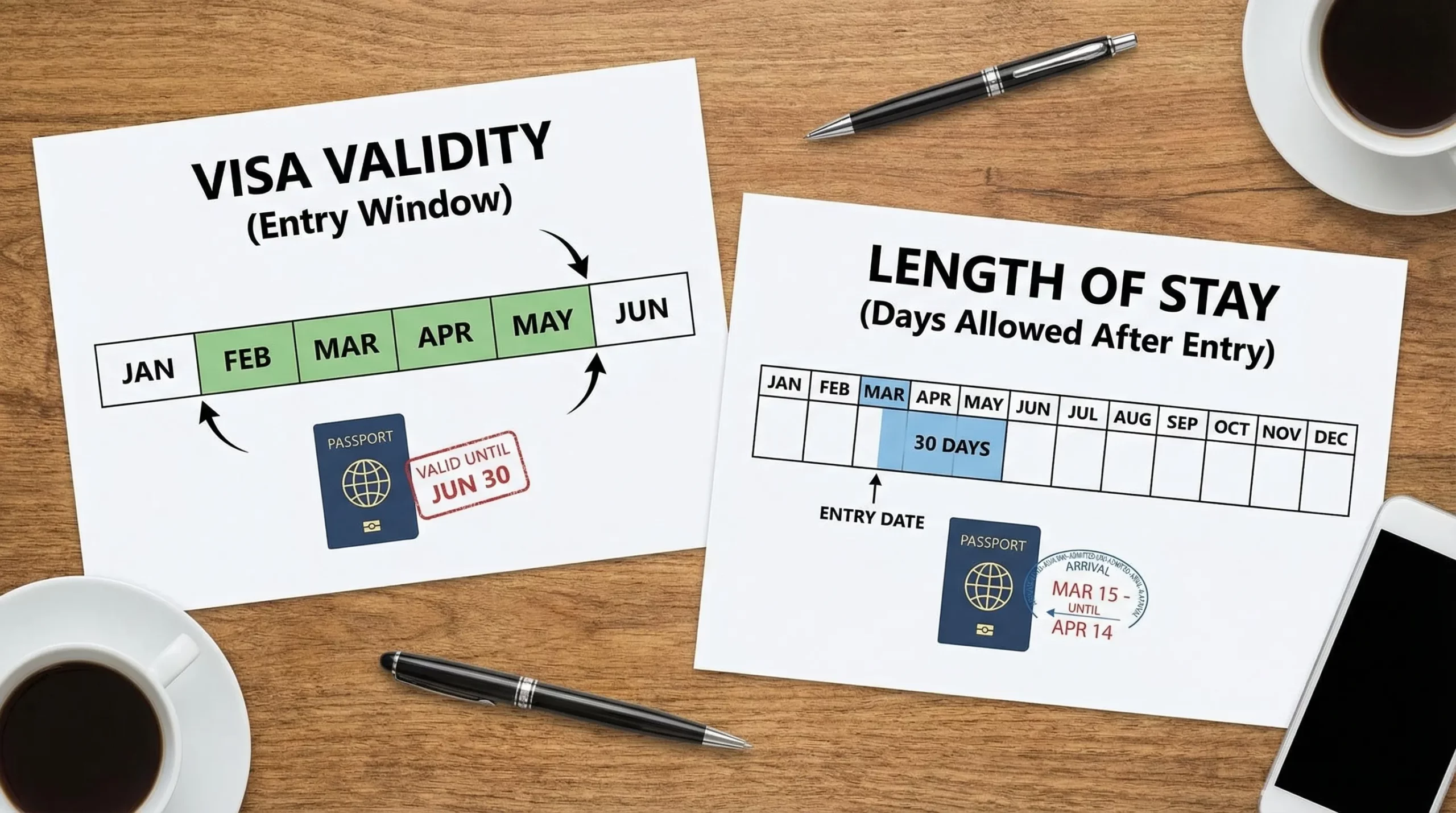
Visa validity is the window of time when you are allowed to use the visa to request entry. Think of it as the “use-by period” for showing up at the border.
- If your visa is valid from June 1 to August 30, it typically means you can attempt to enter during that period.
- It does not automatically mean you can stay until August 30.
A visa can be valid for years (for example, some long-validity visitor visas), while each individual visit is still limited.
Length of stay (also called “duration of stay” or “period of stay”)
Length of stay is how long you can remain in the country after each entry, often counted in days.
Depending on the country and document type, the length of stay may be:
- A fixed number of days per entry (example: “30 days per visit”)
- Limited by a rolling rule (example: “90 days in any 180-day period”)
- Determined at the border (example: the officer issues a stamp or digital entry record that controls the allowed stay)
Why the confusion happens more often with eVisas
With an electronic visa (eVisa) or electronic travel authorization (ETA/ESTA-type document), travelers often only see a PDF approval or an email confirmation. That document can show multiple date fields and conditions, sometimes using unfamiliar immigration wording.
The result: travelers read the “valid until” date and assume it is their last day in the country.
Quick reference: validity vs stay vs entries
Here is the simplest way to separate the concepts.
| Term | What it controls | The question it answers | Common mistake |
|---|---|---|---|
| Visa validity | When you can arrive and request entry | “By what date do I need to enter?” | Assuming validity equals permitted stay |
| Length of stay | How long you can remain after entry | “How many days can I stay this trip?” | Not checking the entry stamp or entry record |
| Number of entries | How many times you can use the document | “Can I leave and come back on the same visa?” | Assuming you can re-enter unlimited times |
If you remember only one line, use this:
Validity tells you when to enter. Length of stay tells you when to leave.
Real-world examples (so you can spot the trap)
Example 1: “Valid for 90 days” does not always mean “stay 90 days”
Many countries issue eVisas that are valid for entry for 90 days from issuance, but only allow a 30-day stay after you arrive.
If you enter on day 89, you might still only get 30 days in-country (or less, depending on conditions). Your “validity” clock and your “stay” clock are different.
Example 2: A long-validity visa with short stays per visit
Some visitor visas can be valid for multiple years, but each admission might be limited (for example, “up to 6 months per entry,” subject to border approval). In these systems, the visa validity mainly affects when you are allowed to show up, while your actual permitted stay is decided per trip.
In the United States, for instance, the controlling record for most nonimmigrant admissions is the electronic I-94. Travelers can check and download it from the official U.S. CBP I-94 website.
Example 3: Multiple entries are not the same as “continuous stay”
A visa can be valid for multiple entries, but that does not mean you can live in the country continuously until it expires.
Common pattern:
- Visa validity: 1 year
- Entries: multiple
- Length of stay: 30 days per visit
You can use it multiple times within the year, but each visit is capped. If you want to stay longer, you typically need an extension, a different visa type, or to comply with a separate residence process.
Example 4: Rolling stay limits (the 90/180 style rule)
Some regions use rolling windows such as 90 days in any 180-day period. In that model, “length of stay” is not a single number attached to one trip. It is cumulative and depends on your travel history.
If you travel frequently, you can run out of days even though your visa or authorization is still “valid.”
For Schengen short stays, the European Commission provides an official short-stay calculator to help travelers estimate remaining days.
What actually determines your last day in the country?
A practical way to avoid mistakes is to treat your permitted stay as a “decision stack.” The controlling item depends on the country:
- The visa or eVisa approval notice (what you were issued)
- The entry decision at the border (stamp, sticker annotation, or a digital record)
- The immigration status document you receive or can retrieve (for example, an I-94 or local equivalent)
In many destinations, the border officer (or automated border system) can admit you for less time than the maximum allowed by the visa. That is another reason validity dates alone are not enough.
How to read a visa or eVisa without guessing
When you pull up a visa sticker, an eVisa PDF, or an approval email, look for these fields (names vary by country):
- Valid from / Valid until: This is the entry window.
- Duration of stay / Length of stay: This is the per-visit limit (or reference to a rule).
- Number of entries: Single, double, multiple.
- Purpose: Tourism, business, transit, study, work. A mismatch here can create border issues even if the dates look fine.
If any of those are missing, treat it as a red flag and verify using official guidance for that destination.
The three most common planning mistakes (and how to prevent them)
Mistake 1: Booking your return flight based on the validity end date
Fix: Base your departure date on the length of stay (and the entry record), not the visa validity end.
Mistake 2: Confusing “must enter by” with “must leave by”
Some eVisas are issued with language like “enter before” or “valid until.” That is typically about entry. Your “must leave by” date is often calculated separately.
Fix: Write down two separate dates:
- Latest possible entry date
- Latest permitted departure date for your planned entry date
Mistake 3: Assuming re-entry resets everything
With rolling limits (like 90/180), leaving and coming back does not necessarily reset your available days.
Fix: Track cumulative days and use official calculators where available.
What happens if you overstay, even by accident?
Overstays can trigger consequences that are disproportionate to “just a few days,” depending on the country:
- Fines or exit fees
- Detention or removal
- Future visa refusals
- Travel bans or mandatory waiting periods before reapplying
- Increased border scrutiny on later trips
Even if you later obtain a new eVisa, a prior overstay can be visible in immigration systems.
If you think you are at risk of overstaying, treat it as urgent and check options that may exist in some countries (extensions, status changes, emergency appointments). Do not rely on internet anecdotes, rules vary widely.
Special scenarios where validity vs stay confusion is extra costly
“House-hunting” trips and extended travel planning
People often travel on visitor status to explore cities before a move or long-term plan. That is when the validity vs stay misunderstanding hits hardest, because the trip is intentionally longer.
For example, if you are visiting Texas to explore neighborhoods and compare housing options, you might spend time researching local inventory like manufactured homes in San Antonio while you are there. Just make sure your itinerary still fits the per-visit length of stay granted at entry, not the visa’s overall validity period.
Cruise and multi-country itineraries
Cruises and tours can involve re-entries, short transits, and mixed border systems. A visa that is valid for the season might still allow only a limited stay per entry, and some ports can require separate authorizations.
In these itineraries, the “number of entries” field becomes just as important as the stay limit.
Travel businesses: why this confusion becomes a support and conversion problem
If you run an airline, OTA, tour operator, or travel agency, validity vs stay confusion typically shows up as:
- Pre-departure support tickets (“Can I stay until the visa expires?”)
- Last-minute abandonment at checkout when rules look unclear
- Day-of-travel disruption (denied boarding, missed connections)
- Refund and chargeback disputes
The best-performing flows make the rules explicit in plain language, for example: “Valid for entry until Aug 30. Each stay up to 30 days.”
A simple checklist before you fly
Use this quick pre-departure verification to reduce surprises:
- Confirm your visa or eVisa validity window covers your arrival date.
- Confirm your length of stay covers your planned departure date, with buffer for delays.
- Confirm whether your trip needs single or multiple entries.
- Keep a copy of your eVisa approval (digital plus a backup).
- After entry, check your entry stamp or digital entry record and note the permitted until date if provided.
Frequently Asked Questions
Is visa validity the same as the time I’m allowed to stay? No. Visa validity is the period when you can use the visa to request entry. Length of stay is how long you can remain after you enter.
If my eVisa is valid for 180 days, can I stay for 180 days? Not necessarily. Many eVisas are valid for entry for 180 days, but only allow a shorter stay (for example 30, 60, or 90 days) per visit.
Who decides my length of stay, the visa or the border officer? It depends on the country. In many places the border officer (or a digital border system) determines the permitted stay at entry, within the limits of your visa category.
Does leaving the country reset my allowed days? Sometimes, but not always. With rolling limits (like 90 days in any 180-day period), leaving does not reset the clock.
What should I do if my visa validity is fine but my length of stay is not enough? You may need an extension, a different visa type, or to change your travel dates. Do not assume you can “fix it at the airport.”
Make visa rules clearer for customers (and reduce last-minute issues)
If you are a travel brand, the best way to prevent validity vs length of stay mistakes is to surface the right rule, in the right language, at the right time, inside the booking and post-booking journey.
SimpleVisa helps travel businesses streamline border requirement checks and guided applications through API integrations, a white-label visa application app, and no-code implementation options, so travelers see clear instructions like “enter by” versus “stay up to,” and can complete online visa processing without leaving your flow.
Explore SimpleVisa at simplevisa.com to see integration options for your team.