Works in US: Does Your eVisa or ETA Apply for Entry?

A common pre-flight panic goes like this: you already have an approved eVisa (or an ETA) for a different trip, and you assume it “works in US” too. Then you notice your itinerary includes a U.S. connection, a stopover, or the United States as the final destination, and suddenly you are not sure what document actually applies.
This guide clears up the confusion so you can answer one question with confidence:
Does your eVisa or ETA apply for entry to the United States, or do you need a U.S. ESTA or a U.S. visa instead?
First, the key rule: entry permission is country-specific
An eVisa or ETA is issued by one country (or bloc) for entry to that country (or bloc). It generally does not transfer to other destinations.
So:
- An Australia ETA does not authorize U.S. entry.
- A UK ETA does not authorize U.S. entry.
- Future/other European authorizations (like ETIAS for Schengen travel) do not authorize U.S. entry.
For the United States, the most common “digital permission to travel” is ESTA (under the Visa Waiver Program), not an eVisa in the way many travelers use the term.
“Works in US” checklist: what document do you actually have?
Travelers often use “eVisa” as a catch-all for any electronic travel document. But the name matters because it points to the issuing authority and the rules.
Here is a quick orientation.
| Document you have | Who issues it | What it “works” for | Does it apply for U.S. entry? |
|---|---|---|---|
| eVisa (generic) | A specific country | Entry to that specific country | No, unless it is a U.S.-issued document (rare for typical tourism) |
| ETA / eTA (generic) | A specific country | Pre-travel authorization for that country | No |
| ESTA | United States (CBP/DHS) | Visa Waiver Program travel to the U.S. (eligible passports) | Yes, if you meet VWP rules |
| U.S. visitor visa (B-1/B-2) | United States (State Dept.) | Tourism/business visits (non-VWP or ineligible travelers) | Yes |
| U.S. work/study/resident visas | United States | Work, study, immigration pathways | Yes, per visa class |
If you are unsure what you hold, look for the issuing authority on the approval notice and the official portal you used.
When your eVisa or ETA does NOT apply for the U.S.
In most cases, the answer is simple: a non-U.S. eVisa/ETA does not authorize entry to the United States.
That remains true even if:
- Your trip is “just a layover” (you may still need U.S. permission to enter or transit).
- Your airline already issued a boarding pass.
- You have previously visited the U.S. without issues.
If your destination is the U.S. (or you will need to pass U.S. immigration), you typically need either:
- ESTA (if eligible under the Visa Waiver Program), or
- A U.S. visa (if you are not eligible for ESTA, or your trip purpose requires a visa).
Authoritative starting point: the U.S. Customs and Border Protection ESTA site is at Official ESTA application.
The most common U.S. entry paths (and how to choose)
Option 1: You can use ESTA (Visa Waiver Program)
You generally look at ESTA if:
- You are a citizen of a Visa Waiver Program country.
- You have an e-passport.
- Your trip is a qualifying short visit (for example tourism or certain business visits).
ESTA is not a “visa,” but it is often required for air or sea travel to the U.S. for VWP travelers.
If you want a deeper U.S.-specific refresher, SimpleVisa maintains a dedicated guide: US eVisa (ESTA) guide: eligibility, fees, and timelines.
Option 2: You need a U.S. visa (B-1/B-2 or another class)
You generally need a U.S. visa if:
- Your nationality is not in the Visa Waiver Program.
- You were denied ESTA previously (or are not eligible).
- Your purpose of travel requires a different visa class.
For U.S. travel visas, the official reference hub is the U.S. Department of State: U.S. visas information.
Edge cases that trip people up
Even experienced travelers can get caught by details that feel “administrative,” but can cause denied boarding or entry issues.
“I have an EU/UK authorization, so I’m cleared for international travel”
Not for the U.S. Authorizations like UK ETA or Schengen-area permissions (including upcoming systems) are not interchangeable with U.S. requirements.
“I’m only transiting the U.S.”
The U.S. has strict transit rules in many situations. Depending on your nationality and itinerary, you may still need ESTA or a visa to transit.
Your safest approach is to verify U.S. transit rules for your passport and routing, then apply for the correct document well before departure.
“I’m entering by land from Canada or Mexico”
Rules can differ by mode of entry and traveler profile. Many Visa Waiver Program travelers focus on ESTA for air/sea, but land travel can still involve additional procedures and inspection.
If your plan includes mixed modes (for example, flying into Canada then driving into the U.S.), treat it as a separate requirements check, not an assumption.
“My name/passport changed after approval”
Electronic travel documents are typically linked to your passport details. If you renew your passport or change key biographic details, you may need to reapply or update.
As a general rule, never rely on “close enough” matching. Airline systems and border systems are strict about identity data consistency.
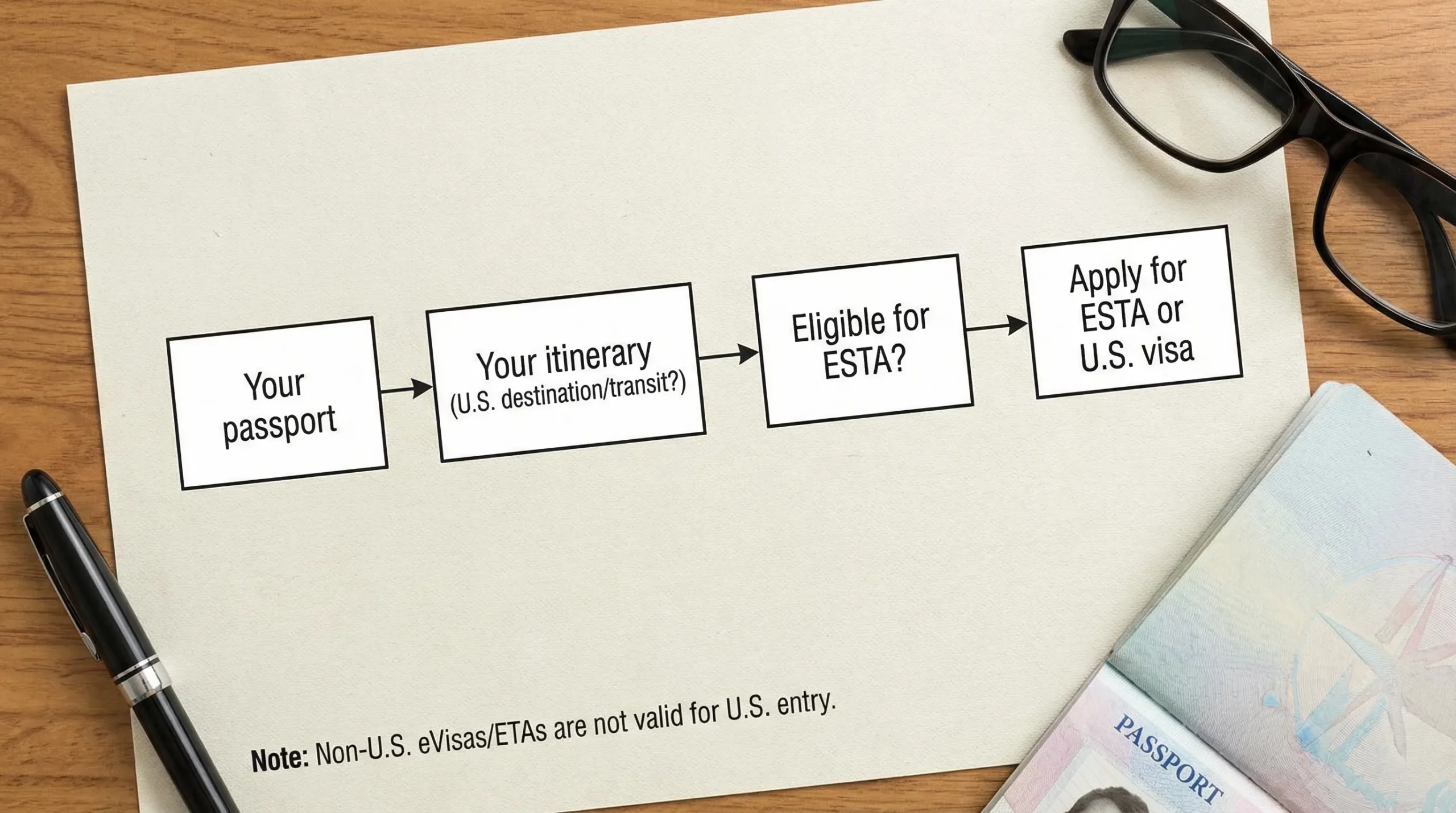
A practical decision flow you can use in 2 minutes
Use this as a quick self-audit before you head to the airport.
| Question | If YES | If NO |
|---|---|---|
| Is the United States a destination or transit point where you must clear immigration? | Continue | Your non-U.S. eVisa/ETA might be sufficient for your actual destination |
| Is your current authorization issued by the U.S. (ESTA or a U.S. visa)? | You may be covered (verify validity and passport match) | Your eVisa/ETA does not apply for U.S. entry |
| Are you eligible for ESTA under the Visa Waiver Program? | Apply for ESTA (if you do not already have it) | Apply for the appropriate U.S. visa |
| Does your passport match the authorization exactly (number, name, DOB)? | Proceed | Fix before travel (update/reapply) |

Don’t confuse “having a document” with “being guaranteed entry”
Even the right authorization (ESTA or visa) does not guarantee admission. Final admission decisions are made at the port of entry by U.S. border officials.
What you can control is reducing avoidable risk:
- Apply using official portals or trusted partners.
- Ensure every field matches your passport.
- Carry any supporting documents relevant to your trip purpose.
What about traveling to the U.S. with pets?
Entry permission for you and entry rules for your pet are separate tracks. If you are planning a U.S. trip with a dog, you will also want to plan logistics like airline pet policies and accommodation.
On the accommodation side, it helps to pre-filter stays that welcome pets. A useful directory for trip planning is this list of dog-friendly hotels and destinations (especially handy if you are building a multi-stop itinerary).
For travel companies: why this question matters operationally
If you run an airline, OTA, tour operator, or cruise business, “Does this eVisa/ETA work in the U.S.?” is not just a traveler question. It is a conversion and compliance question.
When customers guess, you tend to see:
- Last-minute support tickets and long handle times
- Booking abandonment when requirements look confusing
- Denied boarding risk (and the downstream costs)
A better pattern is to surface requirements at booking or post-booking based on passport and itinerary, then guide the customer through the correct flow.
SimpleVisa supports travel brands with visa processing automation, API integration, and white-label options that can be embedded into booking journeys. You can explore the concept at a high level here: Visa requirements by country: a quick reference.
 SimpleVisa.