You Are What I Need: Choosing the Right Visa Support

Visa support can feel like the unglamorous part of travel, right up until it becomes the only thing that matters.
One missing document can trigger denied boarding, a ruined itinerary, chargebacks, and a customer who never books with you again. On the flip side, the right visa support partner can turn compliance into a smoother customer journey (and a legitimate ancillary revenue stream).
This guide is for travel businesses (airlines, OTAs, TMCs, tour operators, cruise lines) and travel advisors who need to choose the right visa support for their customers. Not just “a provider”, but a solution that fits your product, risk profile, and operational reality.
What “visa support” really means in 2026
“Visa support” now spans more than traditional consular visas. For many itineraries, the critical path includes digital authorizations and document workflows:
- eVisas (electronic visas)
- eTAs/ESTA-style authorizations (digital pre-travel permissions)
- New and expanding regional programs (for example, Europe’s upcoming ETIAS and the UK’s ETA)
For travel brands, visa support typically falls into three layers:
1) Requirements intelligence (the “what do I need?” layer)
Rules change, exemptions vary by nationality, and requirements depend on purpose and length of stay. You need accurate, updated guidance that’s easy for customers and agents to understand.
2) Application guidance and processing (the “help me do it” layer)
This is where abandonment and error rates live: long forms, document uploads, fees, and identity details that must match the passport exactly.
3) Operational coverage (the “keep it moving” layer)
Customers need status visibility, support when something fails, and help managing edge cases (passport replacement, corrections, group travel, tight timelines).
Choosing the right visa support means deciding which layers you want to own, and which you want a specialist to handle.
“You are what I need”: Start with the outcomes you’re responsible for
Before comparing vendors, define what your business must protect or improve.
The non-negotiables for most travel sellers
Most teams eventually land on a combination of these outcomes:
- Fewer boarding issues and escalations (compliance risk reduction)
- Higher booking conversion (less friction, more confidence)
- Lower support burden (fewer tickets about entry requirements and form errors)
- Incremental margin (ancillary revenue that does not harm trust)
The questions that clarify your “right fit”
Ask these internally first:
- Where do customers currently get stuck: understanding eligibility, completing forms, paying, or tracking outcomes?
- Do you need this in-flow during booking, post-booking, or both?
- Is your travel mix mostly point-to-point, or multi-country and complex?
- Do you need a consumer-facing experience, an agent-facing back office, or both?
- What’s your tolerance for manual handling when edge cases occur?
If you can’t answer these, it’s hard to evaluate vendors objectively, and easy to get sold features you won’t use.
The three main visa support models (and when each is “what you need”)
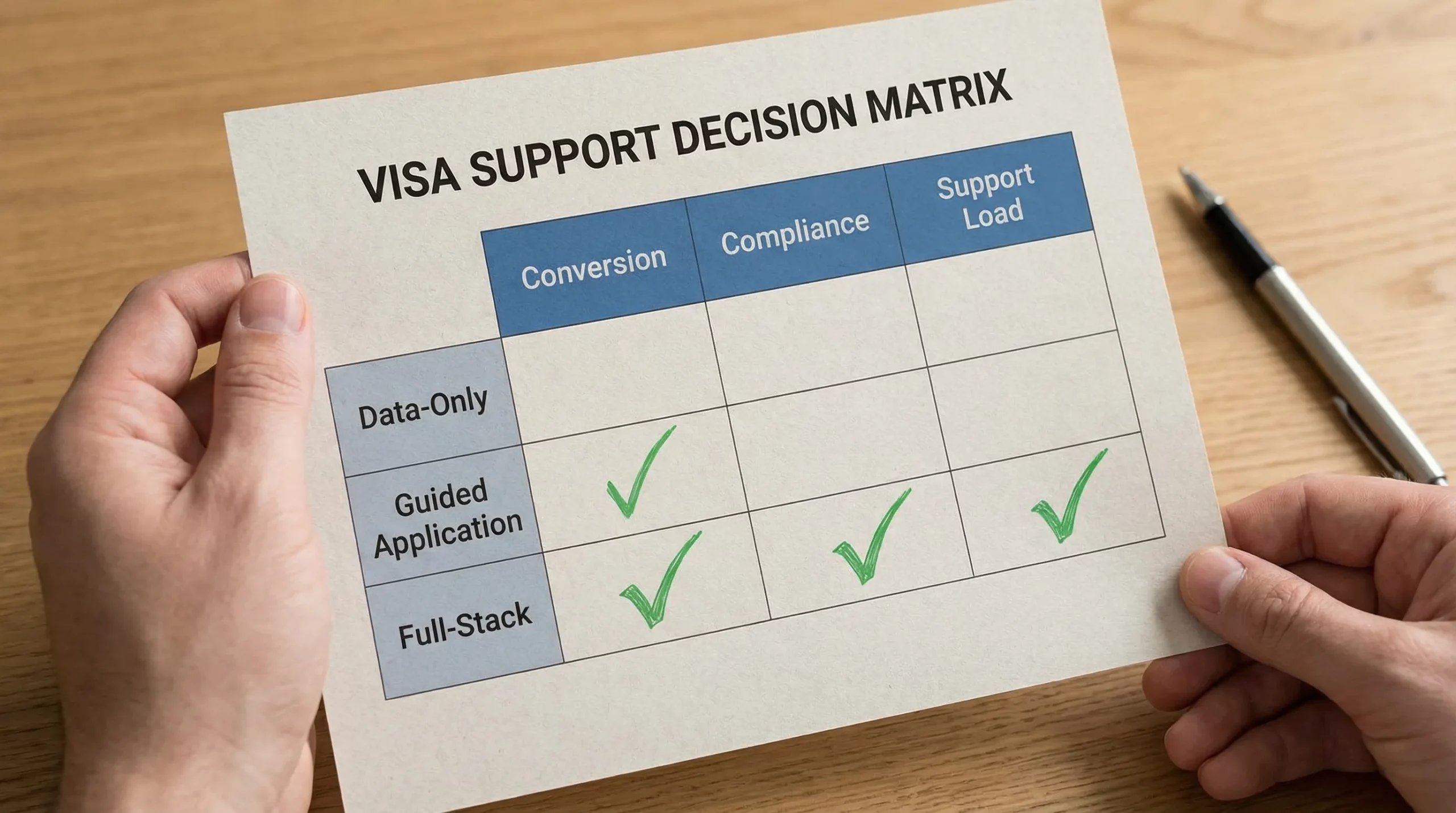
Different providers specialize in different slices of the problem. This table is a useful shortcut for aligning expectations.
| Model | Best for | What you gain | What can go wrong |
|---|---|---|---|
| Information-only provider (requirements data) | Brands that only want eligibility and document requirements surfaced | Quick enablement, low operational complexity | Customers still must complete applications elsewhere, support volume may remain high |
| Application workflow provider (guided digital applications) | Brands that want to reduce errors and improve completion rates | Better UX, fewer mistakes, higher confidence | If coverage is limited, you may need multiple vendors |
| Full-stack visa management (data + workflow + support) | Brands accountable for end-to-end traveler success | Strong operational outcomes and fewer escalations | Requires deeper vendor diligence on security, SLAs, and integration maturity |
Your best choice depends on what you sell and what you’re liable for.
A practical checklist for choosing the right visa support
If you want a single framework, use these seven pillars. They map to what actually breaks in production.
1) Coverage and rule accuracy (including change management)
Coverage is not just “how many countries.” It’s whether the provider can reliably handle:
- Nationality-specific variations
- Transit and multi-stop itineraries
- Time-sensitive changes and policy updates
What to ask vendors:
- How do you source and update requirements?
- How do you communicate rule changes to partners?
- Do you provide versioning, audit trails, or update logs?
2) Customer experience that prevents abandonment
Visa flows lose customers when they feel risky, confusing, or endless.
Look for:
- Clear eligibility answers early
- Guided steps and validation that reduce errors
- Mobile-friendly uploads and form filling
- Transparent pricing and realistic timelines
A vendor demo should show how they handle the messy moments: name mismatches, rejected photos, missing documents, and payment failures.
3) Security and privacy you can defend
Visa applications involve passports, travel history, and identity data. Your vendor becomes part of your risk surface.
Baseline expectations typically include encryption in transit and at rest, secure authentication, and clear data retention rules. If you serve EU customers, ensure the vendor can support GDPR-aligned processing.
You can also sanity-check your own security posture by referencing established guidance like the U.S. government’s official ESTA portal practices (for context on authorized digital travel authorizations): CBP ESTA.
4) Support model and escalation paths
When something goes wrong, who owns the fix?
Evaluate:
- Coverage hours that match your markets
- SLAs for urgent cases close to departure
- Clear escalation for complex scenarios (for example, prior refusals or document disputes)
The most important detail: whether support is designed to help the traveler succeed, or mainly to deflect tickets.
5) Integration options and time-to-market
For travel brands, integration usually falls into three buckets:
- API integration for embedding in booking flows
- White-label app/portal for a branded, faster launch
- No-code implementation for teams without heavy engineering bandwidth
The “right” choice depends on how much UX control you need and how quickly you want to go live.
6) Commercial alignment (and how revenue affects trust)
Visa support can generate revenue, but it can also damage trust if pricing feels opaque.
Look for:
- Clear separation of government fees vs service fees
- Policies for refunds, rework, and rejected applications
- A commercial model that matches your funnel (in-flow upsell vs post-booking attach)
7) Reliability and performance (because travel is deadline-driven)
Even a perfect workflow fails if the system is slow, unstable, or down during peak booking windows.
Ask for:
- Uptime targets
- Incident communication process
- How they handle traffic spikes
If you’re building middleware around a provider (or hosting your own eligibility and orchestration layer), reliable infrastructure matters. Some teams use a managed VPS to run integration services, queues, and monitoring. If you need that kind of environment, a provider like managed VPS hosting from PetroSky can be a practical option, especially when you want predictable performance and support.
Build vs buy: the hidden cost is not the form, it’s the fallout
Many travel teams start with manual processes: FAQs, PDFs, email templates, and a support queue that grows quietly.
The costs typically show up later as:
- Bookings lost because customers aren’t confident about requirements
- Last-minute escalations close to departure
- Operational time spent correcting avoidable errors
- Reputational damage when a trip fails at the border
A specialized visa support partner is often less about “outsourcing paperwork” and more about creating a repeatable, measurable compliance journey.
What to look for in SimpleVisa (if you need a travel-business-first solution)
SimpleVisa positions itself around simplifying border crossing administration for travel businesses, with delivery options that match how travel companies operate:
- Visa processing automation
- API integration for travel sites (for in-flow or post-booking embedding)
- A white-label visa application app
- Custom data services for requirements and eligibility
- Guided customer visa applications and premium eVisa management
If your primary goals are to reduce friction and increase successful completions, those capabilities matter because they align to the real failure points: confusing eligibility, form errors, and operational follow-up.
Two practical indicators that often matter during vendor selection:
- Proven deployment footprint: SimpleVisa states its service is available on 400+ sites, which can be a proxy for integration maturity.
- Commercial fit: the platform is designed to help travel businesses generate ancillary revenue without forcing customers off your experience.
If you’re evaluating partners right now, a clean next step is to compare your current process against a modern workflow and integration model (API vs white-label vs no-code). You can also explore SimpleVisa’s broader perspective on vendor evaluation in its guide to how to evaluate a visa processing company.
A final gut-check: the right visa support should make you feel calmer
“You are what I need” is a useful standard for vendor selection. The right visa support partner should reduce anxiety, not add another fragile dependency.
When you review options, prioritize the basics that protect your business:
- Accurate requirements and fast updates
- A workflow that customers actually finish
- Security you can stand behind
- Support that resolves issues, not just responds
- Integration that matches your product roadmap
If a provider can prove those five things with real demos, documentation, and operational clarity, you’re not just choosing a vendor. You’re choosing fewer travel disruptions and a smoother path to growth.