Ancillary Revenue Ideas Travel Brands Can Launch Fast
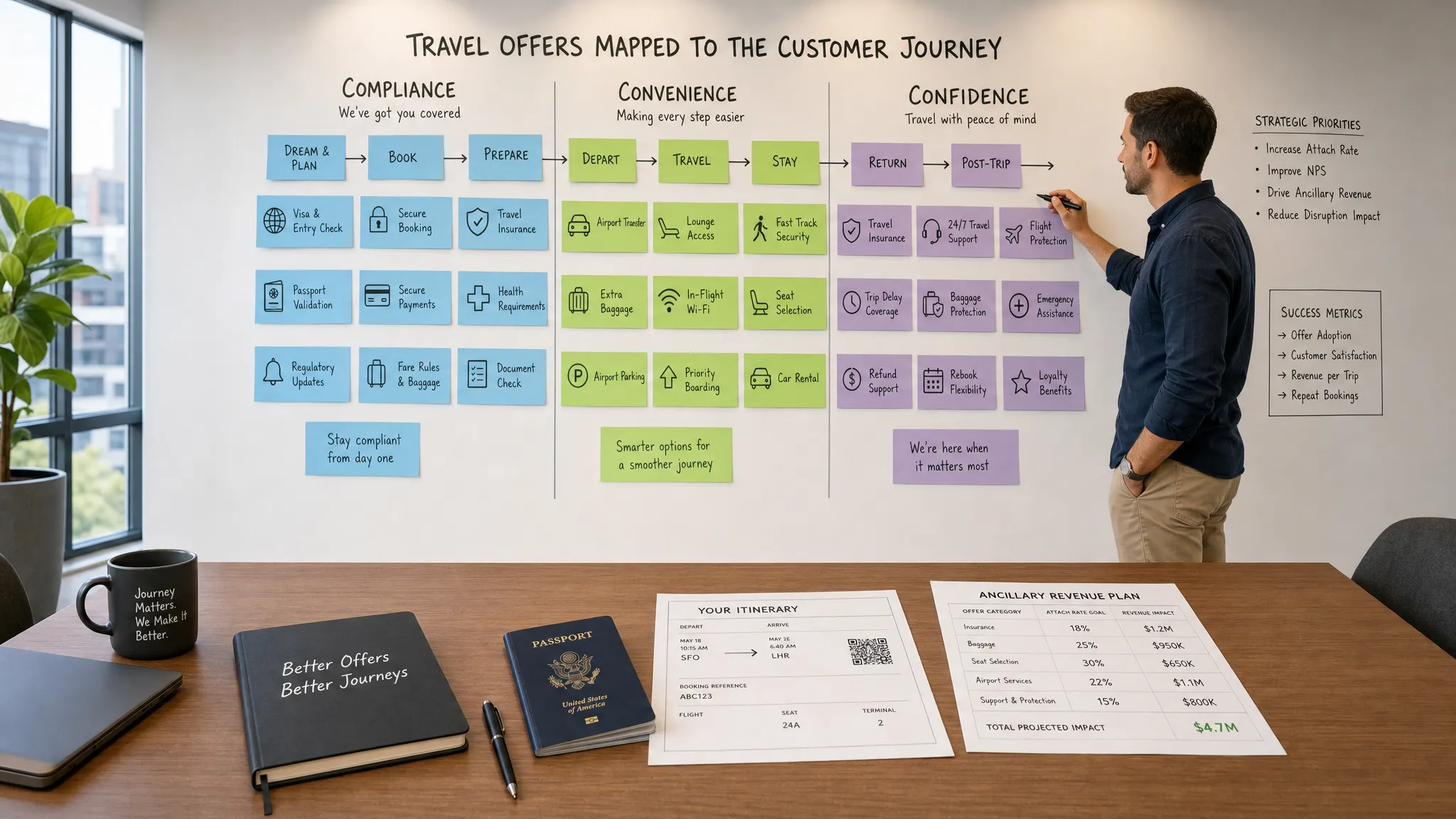
Fast ancillary revenue does not have to start with a six-month roadmap or a deep rebuild of your booking engine. The quickest wins usually come from services that use data you already collect: route, destination, travel dates, traveler nationality, booking status, party size, and trip type.
The key is relevance. A traveler who is three weeks away from an international trip needs different help than someone comparing weekend hotels. If the offer removes friction, reduces risk, or makes the trip easier, it can generate revenue without feeling like an aggressive upsell.
For travel brands in 2026, fast-launch ancillary ideas tend to fall into three categories: compliance, convenience, and confidence. Compliance covers essentials such as visas and entry documents. Convenience covers eSIMs, transfers, parking, bags, lounges, and local transport. Confidence covers insurance, flexible cancellation, missed connection support, and other risk reducers.
If you want the bigger market context before prioritizing tactics, SimpleVisa has a separate overview of the potential of travel ancillary revenues. This guide focuses on what you can actually launch quickly.
What launch-fast ancillary revenue really means
A fast launch is not just a short technical project. It is an offer that can go live without creating operational drag, support confusion, or conversion risk. In practice, the best candidates share a few traits:
- They can be triggered using data already available in the booking journey.
- A specialist partner handles fulfillment, rules, inventory, or customer service.
- The offer can start as a link, widget, white-label flow, email placement, or lightweight API integration.
- The product is easy for travelers to understand in one screen.
- Success can be measured with clear attribution, such as attach rate, revenue per booking, and conversion impact.
This matters because many ancillary programs fail for non-technical reasons. The offer may be profitable on paper, but too broad, shown too early, or hard to explain. Fast does not mean careless. It means choosing offers where the traveler’s need is obvious and the launch path is realistic.
Quick ancillary revenue ideas by speed and fit
Use the table below as a shortlisting tool. The best first move is usually the idea that matches your audience’s most urgent pre-trip problem, not the idea with the longest vendor feature list.
| Ancillary revenue idea | Fastest launch path | Best moment to offer | Best fit |
|---|---|---|---|
| eVisa and entry requirement assistance | White-label flow, partner link, no-code widget, or API | Search results, checkout, confirmation, pre-trip emails | OTAs, airlines, tour operators, TMCs, metasearch |
| Travel insurance or trip protection | Partner widget or post-booking email | Checkout and confirmation | OTAs, tour operators, airlines, accommodation brands |
| eSIM and mobile data | Affiliate link, embedded widget, or email module | Confirmation, 7 to 14 days pre-trip, arrival content | International travel brands and destination apps |
| Airport transfers | Supplier feed, affiliate link, or white-label booking path | Confirmation, pre-arrival emails, app itinerary | OTAs, hotels, airlines, tour operators |
| Parking and car storage | Partner link or location-based module | Pre-trip and day-before reminders | Airlines, airports, rail, cruise, domestic OTAs |
| Lounge access and fast track | Partner marketplace or airport-specific offer | Post-booking and day-of-travel messages | Airlines, airports, premium OTAs, business travel |
| Bags, seats, priority, and fare extras | Supplier integration or NDC-based workflow | Checkout and manage booking | Airlines, OTAs, corporate booking tools |
| Destination activities | Affiliate marketplace or curated landing pages | Confirmation, itinerary emails, in-destination app | Tour operators, OTAs, hotel groups |
| Car rental and local mobility | Partner feed or deep link | Confirmation and destination planning stage | OTAs, airlines, rail, accommodation brands |
| Flexible cancellation or change support | Partner service or own commercial policy | Checkout, especially for higher-value trips | OTAs, package sellers, business travel |
The table is not a ranking. A short-haul domestic brand may see faster results from parking or lounges. A long-haul international OTA may see a better fit with visas, eSIMs, insurance, and transfers. A metasearch site may prefer low-friction prompts that do not compete with core click-outs.
Start with required trip steps, then add convenience
The fastest ancillary revenue ideas often begin with unavoidable traveler needs. If a traveler cannot board, enter the country, contact a driver, or recover from a disruption, the offer is not a luxury. It is trip assurance.
That is why visa and entry requirement support is one of the strongest quick-launch opportunities for international travel brands. It solves a real compliance problem, uses route and nationality data, and can be presented at moments when the traveler is already thinking about trip readiness. For a practical launch plan, see SimpleVisa’s guide on building an ancillary revenue model around eVisa sales in 30 days.
Insurance works in a similar way, although the buying psychology is different. Visa support answers, Can I travel? Insurance answers, What happens if something goes wrong? Both can perform well when explained clearly and placed near the booking or confirmation stage.
Convenience add-ons are usually easier to understand, but they can become noisy if presented too early. eSIMs, transfers, parking, and lounge access tend to work best after purchase, when the traveler has mentally moved from choosing the trip to preparing for it.
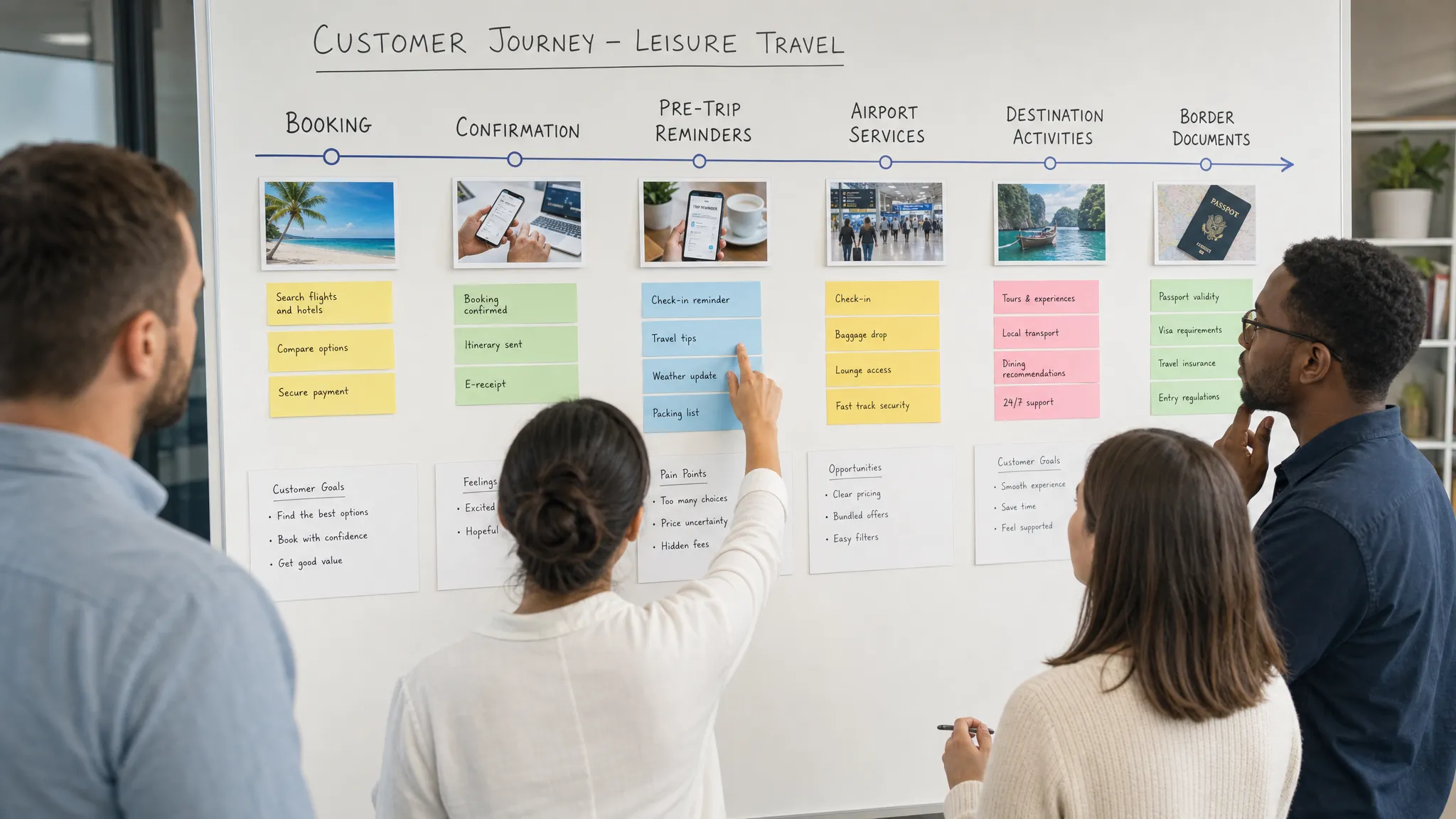
Match each offer to the right point in the journey
Timing is the difference between helpful and intrusive. A checkout page should be protected because it carries the highest conversion risk. Post-booking emails and itinerary pages are more forgiving because the traveler has already committed.
| Journey stage | Good ancillary fit | Why it works |
|---|---|---|
| Search and results | Visa requirement indicators, baggage clarity, fare attributes | Helps travelers compare true trip cost and feasibility |
| Checkout | High-urgency essentials such as entry documents, insurance, bags, seat selection | The traveler is making final trip decisions |
| Confirmation page | eVisa help, insurance reminder, transfers, eSIM, parking | The booking is complete, so conversion risk is lower |
| Pre-trip emails | Entry document reminders, check-in support, lounge, fast track, eSIM | Urgency increases as departure approaches |
| Manage booking or itinerary | Seats, bags, upgrades, changes, transfers, local mobility | The traveler is already organizing trip details |
| In-destination touchpoints | Activities, local transport, restaurant bookings, support services | The traveler is ready to spend locally |
A simple rule works well: put required and time-sensitive services earlier, then shift nice-to-have services into confirmation, itinerary, and reminder channels. This keeps the booking path clean while still giving travelers multiple chances to buy.
The best fast-launch ideas in more detail
1. eVisa and entry requirement assistance
For international trips, entry requirements are both a traveler pain point and a commercial opportunity. The traveler may not know whether they need a visa, ETA, passport validity check, health declaration, or supporting documents until late in the process. If your brand can guide them earlier, you reduce anxiety and create a relevant ancillary revenue stream.
This is especially strong for brands that already know the route, dates, and traveler nationality. You can start with a simple eligibility prompt, then route travelers into a guided application experience. Over time, you can make the experience more integrated through an API or data service.
The key is trust. Avoid vague prompts such as Need travel documents? Instead, make the requirement specific to the trip and explain what happens next. A clear compliance offer will usually outperform a generic upsell.
2. eSIM and mobile data
Connectivity is a natural post-booking product. Travelers understand the problem, the value is immediate, and fulfillment is typically digital. It is also a good fit for email, app itinerary, and pre-arrival messaging because the need becomes more concrete as departure gets closer.
To launch fast, begin with destination-based offers rather than complex personalization. For example, show international travelers a mobile data option in the confirmation email and again one week before departure. Avoid showing eSIM offers to domestic travelers or routes where roaming is unlikely to be a concern.
3. Travel insurance and trip protection
Insurance is one of the most established ancillary categories, but it still works best when the message is contextual. A family package holiday, an expensive long-haul itinerary, and a last-minute business trip have different risk profiles.
Fast launches often start with a partner integration at checkout, followed by a post-booking reminder for those who skipped it. Keep language simple and avoid legal clutter in the primary offer card. Travelers need to understand the broad value first, then review policy details before purchase.
4. Transfers, parking, and local mobility
Ground transportation is a practical add-on because it connects directly to the traveler’s arrival or departure experience. Airport transfers can be especially strong for international arrivals, late-night flights, group travel, and destinations where public transport is difficult.
Parking works better for brands that know the departure airport or station and serve domestic or regional travelers. Local mobility, such as car rental, ride credits, or rail passes, can be introduced after confirmation when travelers begin planning how they will move around.
The operational risk is reliability. If a transfer supplier fails, the traveler may blame your brand. Start with reputable partners and limit initial coverage to markets where supply quality is strong.
5. Lounge, fast track, and airport comfort
Lounge access and fast track appeal to travelers who are time-sensitive, traveling with children, facing long layovers, or flying at peak periods. They can also complement premium packages without requiring you to change the core booking product.
These offers are often better after purchase than during checkout. The traveler may reject them while paying for the trip, then reconsider when they see a long connection or early airport arrival time in their itinerary.
6. Bags, seats, priority, and fare extras
For airlines and OTAs, supplier add-ons such as baggage, seats, priority boarding, and fare bundles can be high-intent because they shape the actual travel experience. The challenge is that they may require deeper supplier connectivity, accurate pricing, and careful handling of changes.
If you can access these products reliably, show them where they help the traveler make a complete decision. Baggage is often useful in search and checkout because it affects total trip cost. Seat selection and priority can work in manage booking and check-in flows.
7. Destination activities and experiences
Tours, attractions, events, and restaurant reservations can create incremental revenue, but they are rarely the first fast-launch choice unless you already have strong destination content or a large post-booking audience. They work best when curated around trip context, not when dumped into a generic marketplace.
A good starting point is a small set of high-confidence categories: airport-to-city essentials, family-friendly attractions, skip-the-line experiences, and day trips in top destinations. Curation usually beats volume.
How to choose your first three launches
If you try to launch every idea at once, you will dilute focus and make measurement harder. Pick three offers that cover different traveler needs and journey stages. A strong first portfolio for an international OTA might be eVisa support, insurance, and eSIM. A domestic airline might start with bags, parking, and lounge access. A tour operator might choose visas, transfers, and destination activities.
Use four filters before adding an offer to the roadmap:
- Traveler urgency: Does the traveler clearly need this before or during the trip?
- Data fit: Can you trigger the offer using data you already have?
- Fulfillment simplicity: Can a partner handle the heavy operational work?
- Conversion safety: Can you place it without distracting from the booking?
The final filter is brand trust. Ancillary revenue grows fastest when customers feel helped, not harvested. Make pricing transparent, make service ownership clear, and avoid presenting optional extras as mandatory unless they truly are required.
Measurement: prove the offer adds revenue without harming the core sale
A quick launch still needs disciplined measurement. At minimum, track attach rate, ancillary conversion rate, revenue per booking, revenue per visitor, refund rate, customer support contact rate, and impact on core booking conversion.
Post-booking offers should be measured separately from checkout offers. A lower attach rate after confirmation may still be attractive if it carries no checkout conversion risk. Similarly, a visa prompt in search may not convert immediately, but it can reduce later support contacts and improve trip readiness.
UTMs, event tracking, and clean partner reporting are essential if you want finance, product, and marketing teams to trust the numbers. SimpleVisa covers this in more depth in its guide to measuring ancillary revenue from eVisa sales, and the same principles apply to other ancillary categories.
A 10-business-day launch plan
You can move quickly without skipping the basics. A focused first launch can look like this:
- Days 1 to 2: Select the offer and audience: Choose one route, destination group, customer segment, or booking channel where the need is obvious.
- Days 3 to 4: Confirm the commercial and operational model: Agree on commission, service fees, support ownership, refund handling, and reporting.
- Days 5 to 6: Build the placement: Start with a confirmation page, email module, no-code widget, or white-label landing page before committing to deeper integration.
- Days 7 to 8: Set up tracking and QA: Test links, UTMs, events, eligibility logic, copy, mobile rendering, and customer service handoffs.
- Days 9 to 10: Launch a controlled test: Limit the rollout, monitor conversion and support signals daily, then expand only if the offer is performing cleanly.
This approach is intentionally narrow. The goal is not to design the perfect ancillary marketplace. The goal is to prove that one useful offer can generate incremental revenue and improve the traveler experience.
Common mistakes that slow launches down
The biggest mistake is treating ancillary revenue as a list of products instead of a journey design problem. Travelers do not want ten offers at once. They want the right help at the right moment.
Another common mistake is placing every offer in checkout because it is the most visible page. Checkout visibility is valuable, but it is also risky. If the offer is not essential to the purchase decision, test it after confirmation first.
Finally, avoid launching without support clarity. Even if a partner fulfills the service, customers may contact your brand when something goes wrong. Define who answers questions, who handles refunds, and how escalations move between teams before the first customer buys.
Frequently Asked Questions
What ancillary revenue ideas can travel brands launch fastest? The fastest ideas are usually partner-led services that use existing booking data, such as eVisa assistance, insurance, eSIMs, airport transfers, parking, lounge access, and destination activities.
Will ancillary offers hurt checkout conversion? They can if they are irrelevant, too numerous, or placed too early. Protect checkout by showing only essential or high-intent offers there, then use confirmation pages, itinerary pages, and pre-trip emails for convenience products.
Why are eVisas a strong ancillary revenue opportunity? eVisas and entry requirements solve a real compliance problem. When a traveler needs authorization to enter a destination, guidance is highly relevant and time-sensitive, which makes the offer more useful than a generic upsell.
How should travel brands measure ancillary revenue? Track attach rate, conversion rate, revenue per booking, revenue per visitor, refund rate, support contact rate, and the impact on core booking conversion. Segment results by journey stage and customer type.
What is the best place to launch a new ancillary offer? For most fast launches, start after booking on the confirmation page or in pre-trip emails. Once you know the offer performs and does not create support issues, test earlier placements such as checkout or search.
Turn border requirements into a fast-launch ancillary stream
If your brand sells international travel, visa and entry requirement support is one of the most practical ancillary revenue ideas to test quickly. It is relevant, time-sensitive, and directly connected to whether the traveler can complete the trip.
SimpleVisa helps travel businesses guide customers through border requirements with integration options that include API, white-label app, custom data services, and no-code implementation. If you want to add a compliant, traveler-friendly ancillary offer without building visa operations from scratch, SimpleVisa can help you get started quickly.