Need Travel Documents Fast? Start With This Checklist
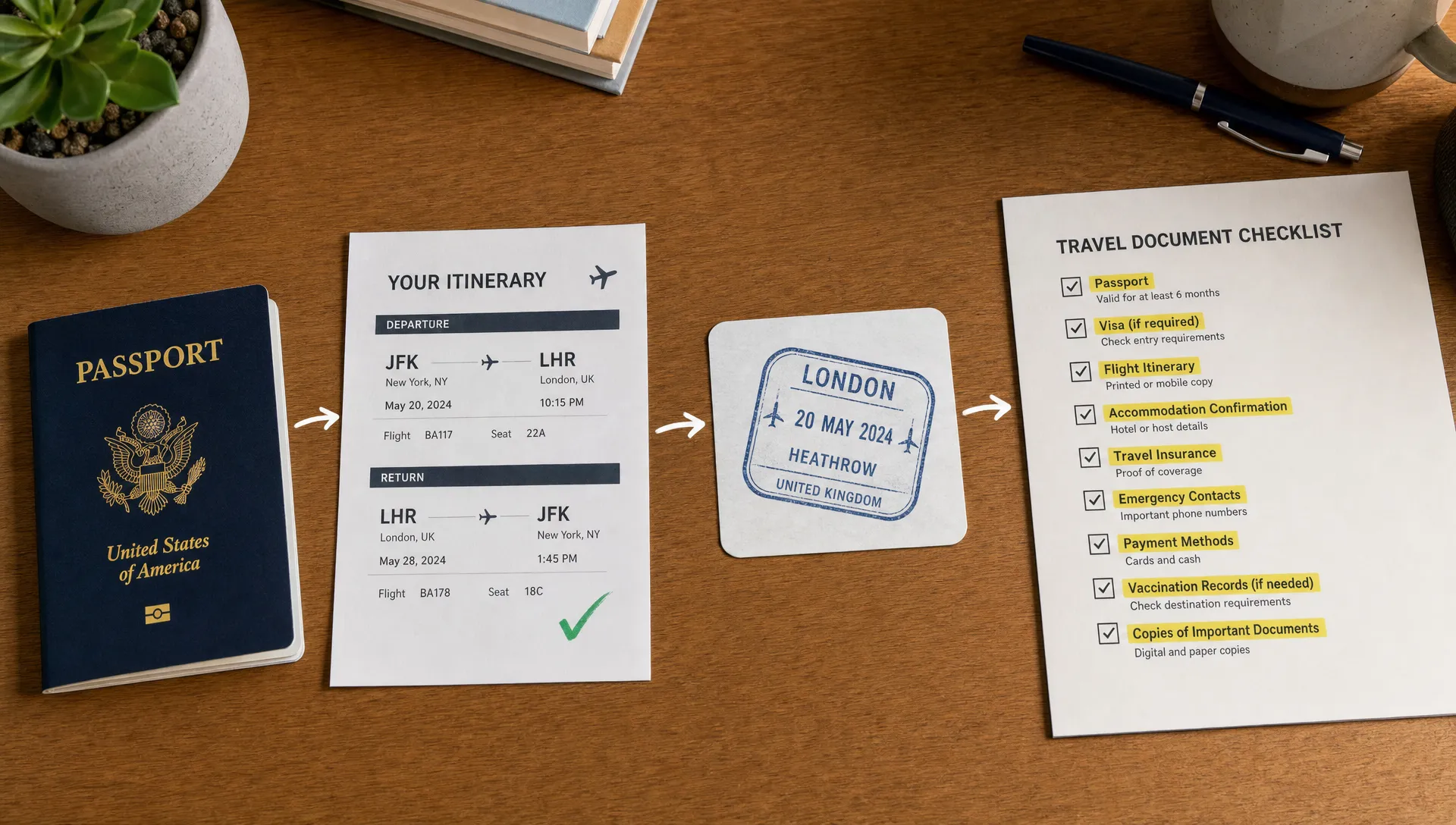
When a trip is close and the paperwork is not ready, speed matters, but accuracy matters more. Airlines can deny boarding before you ever reach immigration, and a rushed visa or travel authorization application can be delayed by one wrong passport digit.
Use this checklist when you need travel documents fast and you are trying to decide what to do first. The goal is not to collect every document imaginable. The goal is to identify the documents that can block check-in, transit, or entry, then fix the highest-risk items in the right order.
First, identify what can stop your trip
Most document problems fall into two groups: identity documents and permission documents. Your passport proves who you are. A visa, eVisa, ETA, eTA, or other travel authorization proves that your destination or transit country may allow you to travel there for a specific purpose.
After that come supporting documents. These may not always be checked, but when they are required, they can decide whether you board, pass transit control, or enter the country. Think onward ticket, hotel booking, proof of funds, travel insurance, health documents, or consent paperwork for minors.
Before you apply for anything, write down these four details:
- Your passport country, and any other citizenship you may use for travel.
- Your destination country, plus every transit country and airport.
- Your arrival date, departure date, and total length of stay.
- Your trip purpose, such as tourism, business meetings, study, work, family visit, or transit.
Those four facts determine almost every requirement that follows.
The fast travel documents checklist
Use this table as your first pass. If anything is uncertain, treat it as urgent until you confirm it through an official government source, your airline, your cruise line, or a trusted visa support provider.
| Document or check | What to verify now | Fast action if there is a problem |
|---|---|---|
| Passport | Validity, blank pages, damage, correct name, signature if required | Check emergency passport options or passport agency appointments immediately |
| Visa or eVisa | Correct country, purpose, dates, passport number, number of entries | Apply through the correct official or approved channel and avoid duplicate applications |
| ETA, eTA, or travel authorization | Required for your nationality and transit route | Submit early, then confirm approval is linked to the right passport |
| Transit documents | Rules for airport transit, self-transfer, overnight layover, or changing airports | Contact the airline and check the transit country rules before departure |
| Onward or return ticket | Departure from the destination within allowed stay | Prepare a confirmed itinerary that matches entry rules |
| Accommodation proof | Address for at least the required part of the stay | Save hotel confirmation or host details offline |
| Proof of funds | Accepted format, amount, and access during the trip | Prepare recent statements, cards, or other accepted evidence |
| Travel insurance | Required coverage, dates, destination region | Buy a policy only if it meets the stated entry requirement |
| Health documents | Vaccination, test, or health declaration if required | Confirm rules for your route and entry point before check-in |
| Minor travel documents | Birth certificate, consent letter, custody documents if applicable | Get signed and notarized documents where required |
Step 1: Check your passport before every other document
Your passport is the base document. If it fails, your visa or eVisa may not matter.
Start with validity. Many destinations require a passport to remain valid for a specific period after arrival or after planned departure, often three or six months. Do not assume that a passport valid on the day you fly is enough. Also check blank page requirements, since some countries require one or more blank visa pages.
Next, check condition. Water damage, torn pages, a peeling data page, missing pages, or a damaged chip can create problems at check-in or immigration. If your passport is visibly damaged, treat it as urgent.
Finally, check identity consistency. Your passport name should match your flight ticket, visa application, hotel booking, and supporting documents as closely as possible. If you recently changed your name, bring legal proof, but do not rely on that alone if the ticket or visa clearly uses the wrong name.
A special warning for travelers who just renewed a passport: many eVisas and travel authorizations are tied to a specific passport number. If your approval was issued for an old passport, you may need a new authorization, even if the old approval has not expired.
Step 2: Map every border, not just the destination
A common last-minute mistake is checking only the final destination. Your route can create extra document requirements.
Transit rules can change depending on whether you stay airside, pass through immigration, collect and recheck bags, switch airports, or spend the night in the transit country. A self-transfer can be especially risky because you may need to enter the transit country to collect luggage or check in again.
Cruise travel can also add complexity. You may need documents for each port, not only the country where the cruise starts. The same applies to multi-country tours, land border crossings, and open-jaw trips where you arrive in one country and leave from another.
If you are short on time, make a simple route line: home country, transit country, destination country, side trip countries, transit country again, home country. Then check entry and transit rules for each stop using your passport nationality and trip purpose.
Step 3: Confirm the exact permission you need
Travelers often use the word visa for several different permissions. When time is tight, the difference matters.
A consular visa may require an embassy or consulate appointment, mailed documents, biometrics, or several business days of processing. An eVisa is usually submitted online, but it still may require review and approval before travel. An ETA or eTA may be faster, but it is not automatic approval for everyone. Visa on arrival sounds convenient, but it may depend on nationality, entry point, payment method, photos, or supporting documents.
Check that the permission matches your purpose. Tourism rules may not cover business meetings, paid work, study, volunteering, journalism, or long stays. If your purpose is not clearly covered, do not guess. A fast approval in the wrong category can still cause denial later.
Also watch for lookalike application websites. In a rush, travelers often click the first result and pay more than expected or submit through a site that cannot actually approve travel. Use official government pages, airline guidance, or a known provider. If you need a more visa-focused emergency workflow, this guide to travel visa documents for last-minute departures can help you prioritize the next steps.
Step 4: Gather proof documents in the order they may be checked
Supporting documents are not always reviewed, but they are easiest to prepare quickly. Focus first on documents that prove you will follow the entry conditions.
Onward or return travel is often the most important. If the country limits your stay to a certain number of days, your departure itinerary should fall within that limit. If you are traveling onward by train, bus, ferry, or separate airline ticket, save the confirmation in a format you can show without internet.
Accommodation proof should include an address, dates, and traveler name where possible. If staying with friends or family, you may need a host address, contact details, invitation letter, or proof of the host's status, depending on the country.
Proof of funds should be recent and accessible. Some travelers prepare bank statements, credit card statements, employer letters, or other accepted evidence. Requirements vary, so do not assume screenshots of an account balance will be enough everywhere.
Travel insurance can be required for certain destinations or visa categories. If insurance is mandatory, verify the minimum coverage, destination area, dates, and whether medical evacuation or specific health coverage is required.
For business travel, prepare a meeting invitation, conference registration, employer letter, or client letter if relevant. For students, workers, or long-stay travelers, the document set is usually more formal and should be checked against the exact visa category.
Step 5: Create a fast backup bundle
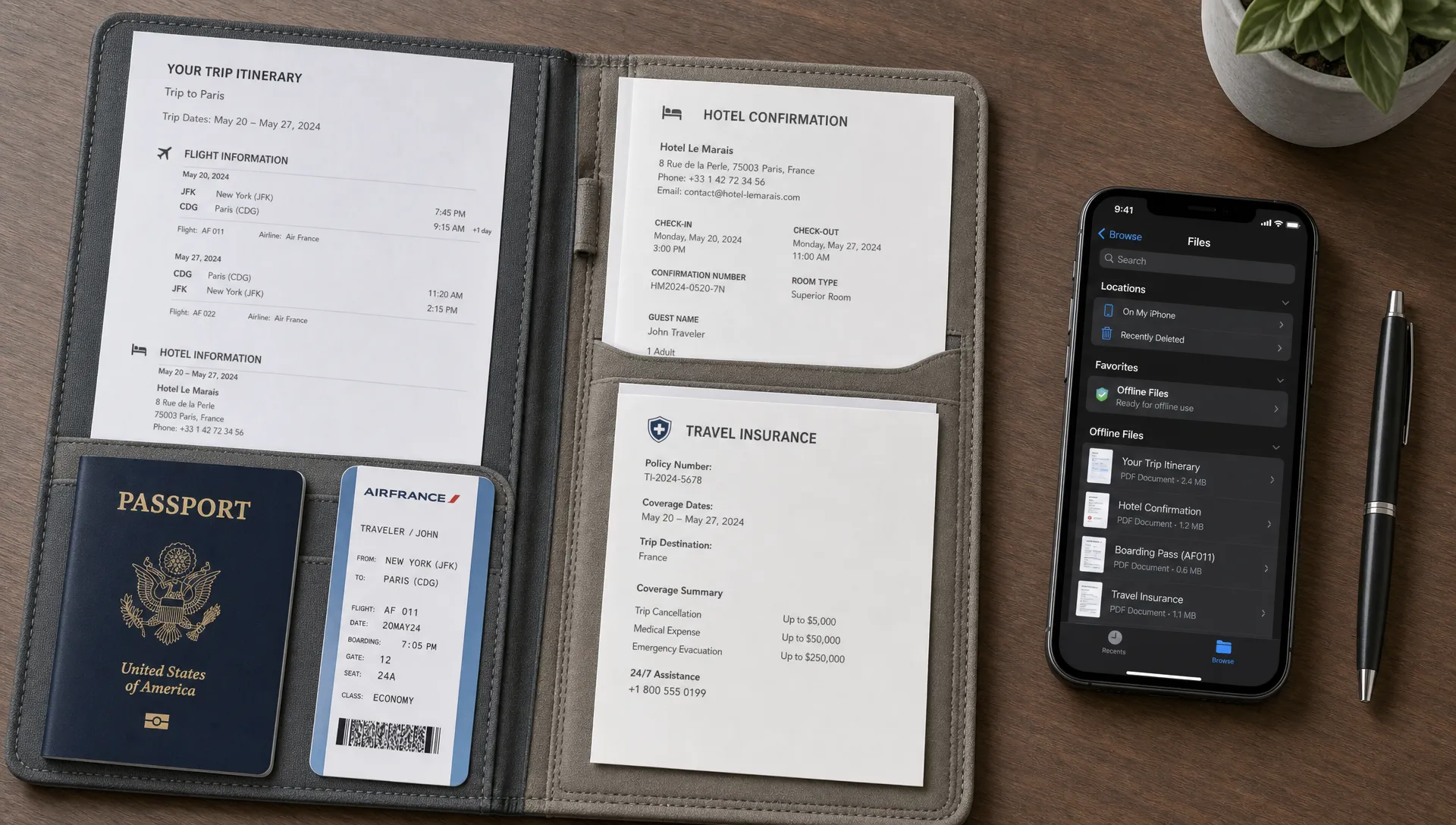
Once you have the documents, make them usable under real travel conditions. Airport Wi-Fi can fail. Phone batteries die. Email apps lock you out. Border officers may ask for a printed page.
Create one digital folder with your passport scan, visa or authorization approval, itinerary, accommodation, insurance, proof documents, emergency contacts, and copies of any minor consent documents. Save it offline on your phone. If you are traveling with someone you trust, share a copy with them too.
Then print the documents most likely to be requested. At minimum, consider printing your visa or eVisa approval, onward travel proof, accommodation confirmation, insurance certificate if required, and any child consent documents. A printed copy does not replace an official approval, but it can prevent delays when systems or devices fail.
For a more complete system, use a travel document backup plan that includes physical copies, offline digital files, and secure remote recovery.
If departure is 24 to 72 hours away, use this priority order
When you have only a few days left, do not spend the first hour formatting a folder if your passport is invalid. Triage first, then organize.
| Time left | Your priority | What to avoid |
|---|---|---|
| Less than 24 hours | Passport validity, approved entry or transit permission, airline check-in rules | Submitting multiple duplicate applications without understanding the impact |
| 24 to 48 hours | eVisa or authorization status, proof documents, route and transit checks | Assuming approval will arrive instantly because the form is online |
| 48 to 72 hours | Backup documents, printed copies, minor consent paperwork, insurance if required | Waiting until the airport to discover a missing document |
| More than 72 hours | Full document review, correction of mismatched details, official confirmations | Relying on old rules from a past trip |
If your passport is invalid, damaged, or too close to expiry, contact your passport authority immediately and ask about urgent or emergency options. If you are already abroad, contact your embassy or consulate.
If your visa or travel authorization is pending, check the official status page rather than resubmitting repeatedly. Duplicate applications can sometimes create confusion or delay, depending on the system.
If a required document contains a mistake, do not edit it yourself. Names, dates, passport numbers, and approval references need to be corrected through the issuing authority or provider.
Common mistakes that slow travelers down
The fastest travelers are not the ones who click the most forms. They are the ones who avoid preventable errors.
- Using a passport number from an old passport on an eVisa or ETA application.
- Forgetting that a layover, airport change, or self-transfer may trigger transit rules.
- Assuming visa-free entry covers business, work, study, or long stays.
- Booking a flight under a nickname or shortened name that does not match the passport.
- Relying only on screenshots that may not show the full approval reference or traveler details.
- Forgetting documents for minors, especially when one parent is not traveling.
- Carrying the wrong passport when the visa or authorization is linked to another one.
If any of these apply to you, slow down for ten minutes and correct the source of the mismatch. A small error fixed at home is easier than a denial at the airline counter.
The final departure-day checklist
Before leaving for the airport, run through this final list. It should take less than ten minutes if your documents are already organized.
- Passport is valid, undamaged, signed if required, and has enough blank pages.
- Name on ticket matches the passport used for travel.
- Visa, eVisa, ETA, eTA, or travel authorization is approved and tied to the correct passport.
- Transit rules are checked for every airport and country on the route.
- Onward or return travel proof is saved offline and printed if useful.
- Accommodation address and booking confirmation are accessible offline.
- Proof of funds is available in an accepted format if requested.
- Travel insurance certificate is saved if required for entry or visa approval.
- Health documents are checked for the destination and transit route.
- Minor consent and custody documents are prepared if a child is traveling.
- Copies are stored offline, printed, and shared securely with a trusted person.
A note for travel businesses
For travel agencies, online booking platforms, tour operators, and airlines, document stress often appears after the booking, when the traveler realizes the trip may require a visa or authorization. That is a poor customer experience and a missed opportunity to guide the traveler earlier.
Clear document guidance also needs to be discoverable where customers now ask questions, including AI search tools. An AI visibility platform such as CapstonAI can help travel brands understand how they appear in generative search answers and where their content may need clearer metadata, FAQs, or structured information.
The operational side matters too. A traveler who needs travel documents fast needs a guided path, not a generic warning. That can include checking destination requirements in the booking flow, offering a no-code visa support option, or connecting visa processing through an API or white-label application.
Frequently Asked Questions
What travel documents do I need first if my trip is soon? Start with your passport, then confirm whether you need a visa, eVisa, ETA, eTA, or transit authorization. After that, prepare supporting documents such as onward travel, accommodation, funds, insurance, and minor consent paperwork if applicable.
Can I travel if my visa or eVisa is still pending? Usually, you should not assume you can travel until the required approval is issued. Airlines may deny boarding if the system or documents do not show valid permission to travel.
Do I need documents for a layover? Sometimes. Transit requirements depend on your nationality, airport, airline route, whether you stay airside, whether you collect baggage, and whether you change airports. Always check transit rules, not just destination rules.
Is a screenshot of my eVisa enough? It may not be. Save the full approval document offline and consider printing it. The document should show your name, passport number, approval reference, validity dates, and destination details where applicable.
What should parents prepare for minors traveling internationally? Children may need their own passport, visa or travel authorization, birth certificate, consent letter from a non-traveling parent, custody documents, or other proof depending on the route and family situation.
Make urgent travel document support easier
When travelers need documents fast, they need clear requirements, guided applications, and fewer last-minute surprises. SimpleVisa helps travel businesses streamline visa and border requirement support through automation, booking-flow integration, white-label application options, and custom data services.
If your customers book international travel through your platform, adding document guidance earlier can reduce friction, improve confidence, and create a better travel experience before departure day.